Esam Mesar: The Art of Creating Symbols That Stay
Discover Esam Mesar, the designer behind the original Half Million logo, and explore his artistic journey, creative philosophy and visual identity work.

Discover Esam Mesar, the designer behind the original Half Million logo, and explore his artistic journey, creative philosophy and visual identity work.
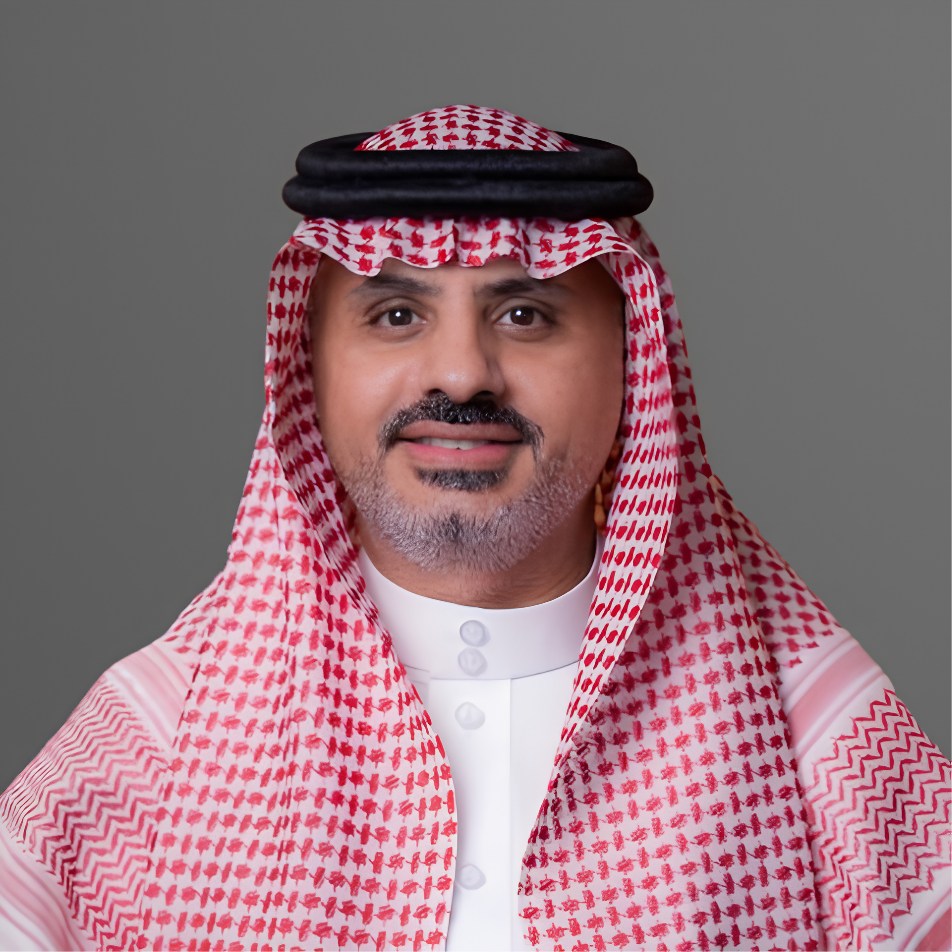
From handwritten Arabic lettering to the original Half Million logo, Riyadh-based designer Esam Mesar explores the relationship between artistic simplicity, visual recognition and time.
You may not know his name, but you have probably encountered his work.
For Esam Mesar (عصام معصار), the designer behind Half Million's original logo, graphic design is an artistic discipline that explores how people recognise, interpret and remember visual forms.
His relationship with Half Million began during the brand's establishment in 2018. Beyond designing its original logo, Mesar was among the early sponsors of its first branch in Riyadh, supporting the concept before it became one of Saudi Arabia's most recognisable coffee brands.
Behind the familiar ½M symbol, however, is a creative journey spanning nearly three decades, shaped by drawing, Arabic calligraphy, curiosity and a fascination with the visual world.
Mesar's relationship with design began long before it became his profession.
Growing up, he was drawn to Arabic calligraphy, drawing, television title sequences and album covers. These everyday encounters with visual expression became opportunities to observe how letters, images and compositions could communicate different personalities and emotions.
Arabic lettering, in particular, offered a space where language and artistic expression could coexist. A letter could become a visual composition, while a word could develop a character of its own through proportion, rhythm and form.
These interests would eventually inform his approach to graphic design, where artistic intuition meets the need to communicate a clear idea.
His creative journey reflects an essential aspect of artistic development: before learning how to design, an artist must develop an understanding of how to see.
In a conversation on the Nahj podcast, Mesar recalled encountering a piece of his own work that dated back to 1997.
It was a handwritten logo he had created for Khafif (خفيف), a popcorn business. Nearly three decades later, he found the lettering still in use at Royal Mall in Riyadh.
The encounter offers an interesting perspective on the relationship between design and time.
Unlike a painting preserved in a gallery, a commercial identity exists within an environment of constant change. It faces evolving consumer preferences, new technologies, changing visual trends and the growth of the business it represents.
For a piece of handwritten lettering to remain in circulation for so long illustrates the possibility of creating something that extends beyond the visual preferences of a particular moment.
It also reveals a recurring theme in Mesar's creative practice: designing for longevity rather than temporary attention.
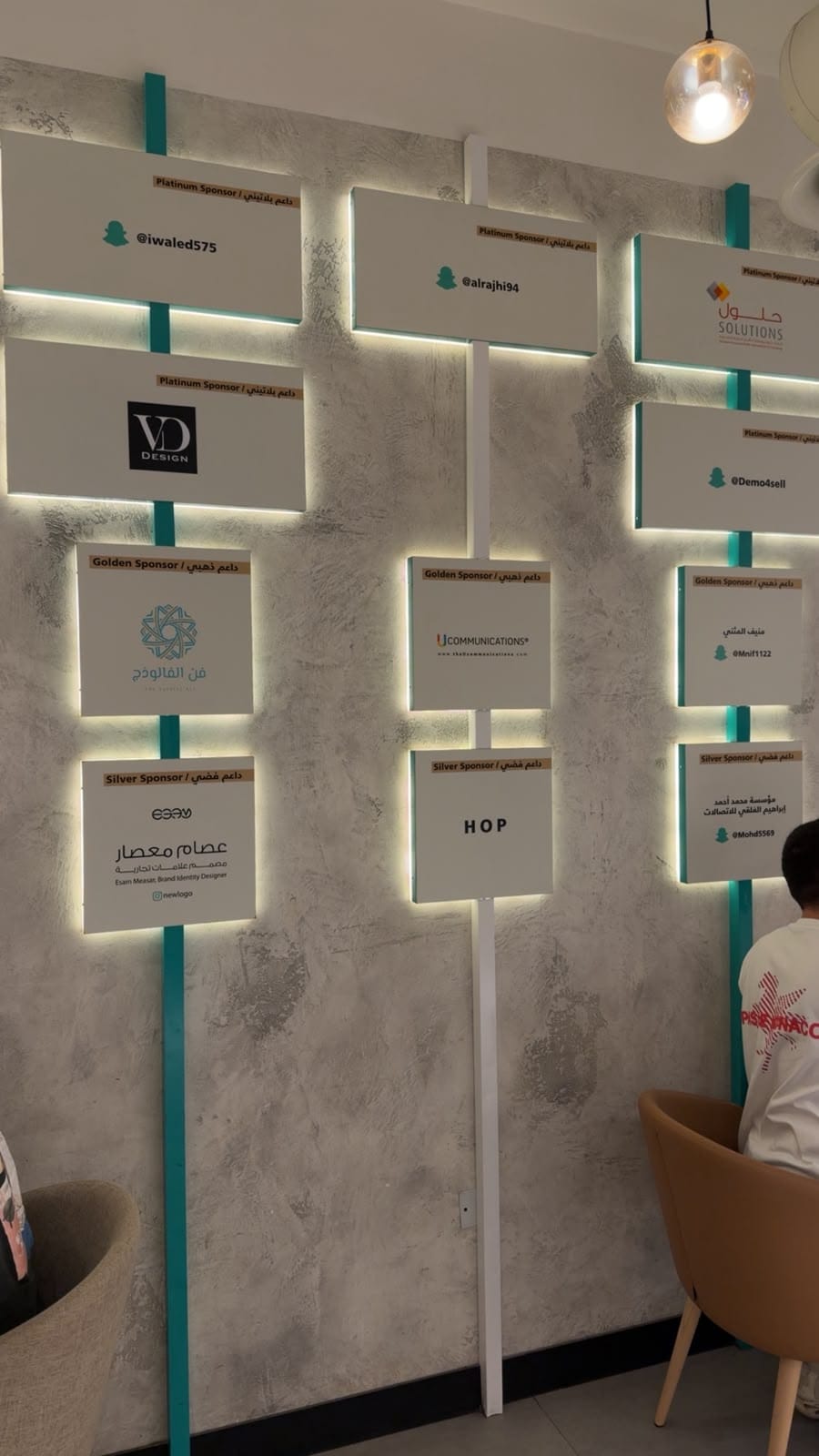
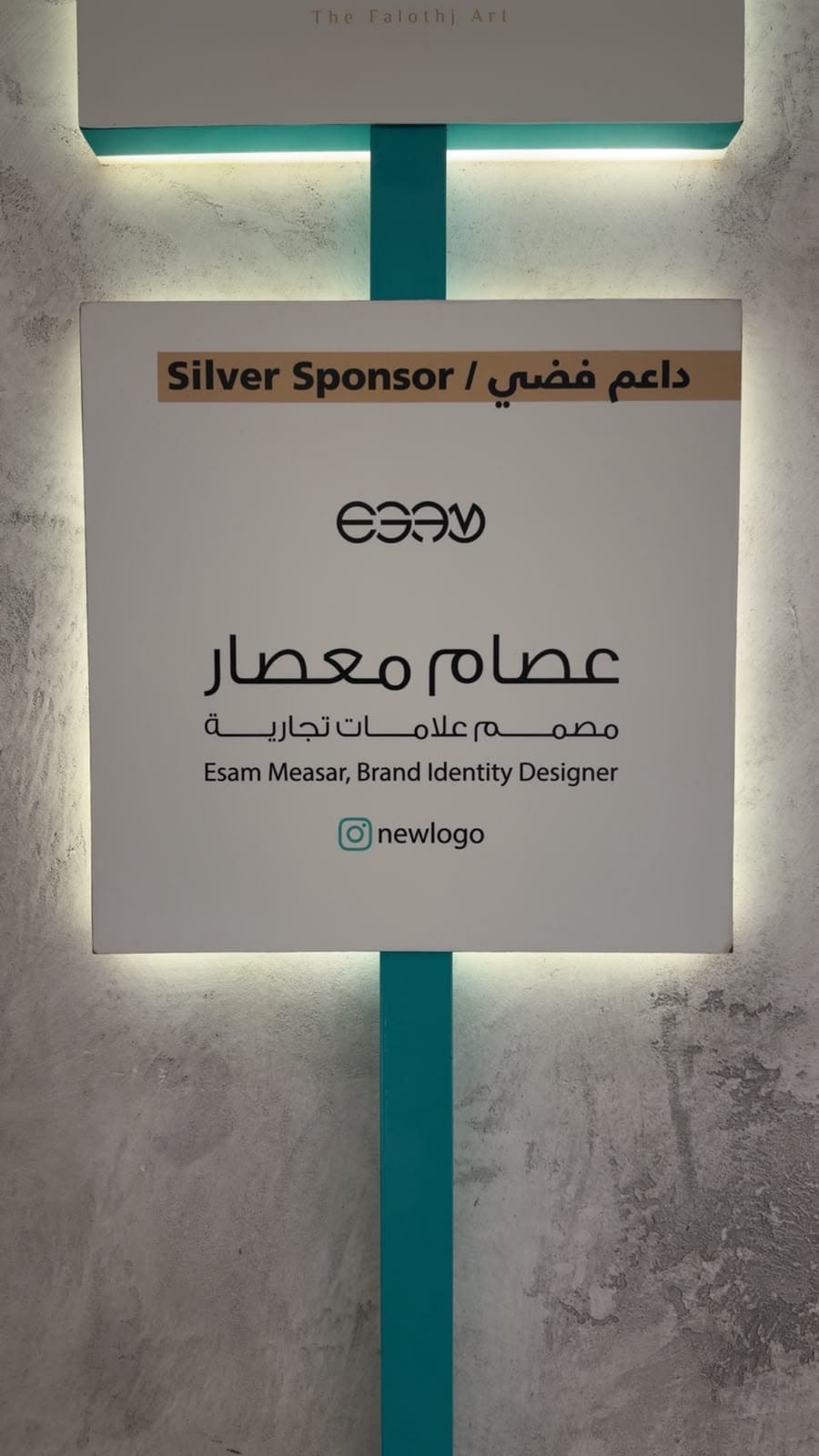
Pictures of the honorary wall of the early supporters of Half Million first branch in Riyadh, AlOlaya.
In 2018, when Half Million was beginning its journey with its first branch in Riyadh, Esam Mesar was among those who supported the emerging coffee brand.
His involvement extended beyond design. As one of the early sponsors of the first branch and the creator of its original logo, Mesar contributed to Half Million at a time when its future was still unwritten.
The logo he created translated the brand's name into a remarkably compact visual expression: ½M.
Rather than relying on conventional coffee imagery, Mesar brought together mathematical notation and typography. The fraction and the letter became a single graphic composition capable of communicating the name without spelling it out.
From an artistic perspective, the mark demonstrates the expressive potential of reduction. Its simplicity allows it to exist across different materials, scales and environments, from coffee cups to storefronts and architectural surfaces.
When Mesar created the logo, Half Million was an emerging business. As the company expanded, the symbol travelled with it, becoming an increasingly familiar feature of Saudi Arabia's commercial landscape.
What makes this story particularly interesting is the relationship between the designer and the early life of the brand. Mesar was not interpreting the identity of an established institution. He was helping give visual form to a business at the beginning of its journey.
Today, thousands of people encounter the symbol, often without knowing the story of its creation or the designer who supported the brand in its earliest days.
This is one of the distinctive qualities of graphic design as an artistic discipline: its ability to enter public consciousness through ordinary encounters.
Podcast Episdoe with Esam Mesar telling his artistic jeourny.
Much of Mesar's design philosophy centres on simplicity. Yet simplicity, in his practice, is not the absence of creative effort. It is the result of it.
Reducing a composition requires decisions about proportion, balance, rhythm and the relationship between its individual elements. The fewer elements a designer uses, the more significant each one becomes.
Mesar discusses the importance of evaluating an identity in black and white before introducing colour. Without colour to influence perception, the designer can examine the strength of the underlying form.
This approach shares principles with sculpture, architecture and abstract art, where the relationship between form and space can be as expressive as the subject itself.
A visual identity must ultimately communicate through its structure, not simply through its decoration.
What appears effortless to the viewer may be the outcome of numerous experiments, revisions and carefully considered decisions.
Another important dimension of Mesar's creative practice is research.
Designing an identity requires entering the world of the subject it represents. A designer working with a healthcare institution must understand a different set of values, expectations and visual associations from one working with a hospitality or fashion brand.
Each project becomes an opportunity to study an unfamiliar subject.
Through New Logo, the Riyadh-based branding company associated with his professional practice, this thinking extends into the development of visual identities informed by research, strategy and creative exploration.
The company's portfolio spans multiple industries, reflecting the versatility required of a designer working across different commercial and cultural contexts.
The process brings together typography, colour, composition and the environments in which a brand will exist.
For Mesar, the creative act begins before the first line is drawn.
As artificial intelligence introduces new possibilities for generating images and accelerating design production, Mesar's reflections on creativity return to the importance of artistic taste.
Access to sophisticated tools does not necessarily develop the ability to evaluate a composition, recognise a meaningful idea or understand why a particular visual expression works.
These abilities emerge through sustained exposure to art, reading, observation and experimentation.
Architecture can inform an understanding of proportion. Photography can develop sensitivity to composition. Calligraphy can reveal the expressive potential of individual lines.
Mesar's engagement with design education reflects this interest in developing creative understanding. In February 2026, Princess Nourah bint Abdulrahman University's Code Lab announced a branding fundamentals workshop led by Mesar, exploring principles and examples from local and international markets.
His approach offers a reminder that the development of a designer is also the development of an observer.
Saudi Arabia's evolving artistic landscape is often documented through exhibitions, cultural institutions, architecture and public installations.
Graphic design offers another perspective.
Every commercial street contains a collection of visual expressions. Storefronts, packaging, signage and typography collectively influence the character of a place. They reflect how businesses communicate, how audiences respond and how visual preferences evolve within society.
Designers such as Esam Mesar contribute to this landscape through work that is experienced outside conventional artistic spaces.
Their creations are encountered by people going about their daily lives, often without knowing who designed them.
This anonymity is an interesting characteristic of commercial graphic design. The work can become widely recognised while its creator remains relatively unknown.
Yet its artistic presence is no less significant.
For Mesar, the journey from handwritten Arabic lettering in 1997 to designing the original Half Million logo in 2018 reflects the enduring possibilities of graphic design as a form of creative expression.
His work invites us to look more closely at the symbols surrounding us, to consider the artistic decisions behind their simplicity and to recognise the designers whose work quietly shapes our visual experience.


An artwork does not always need a gallery to find its audience. Sometimes, it only needs to become part of someone's everyday life.