An Artist in Dialogue: Hatem Al Ahmad
Meet Syrian multidisciplinary artist Hatem Al Ahmad, whose research-led practice brings together environmental questions, archival material, software logic, painting, and installation.


Meet Syrian multidisciplinary artist Hatem Al Ahmad, whose research-led practice brings together environmental questions, archival material, software logic, painting, and installation.
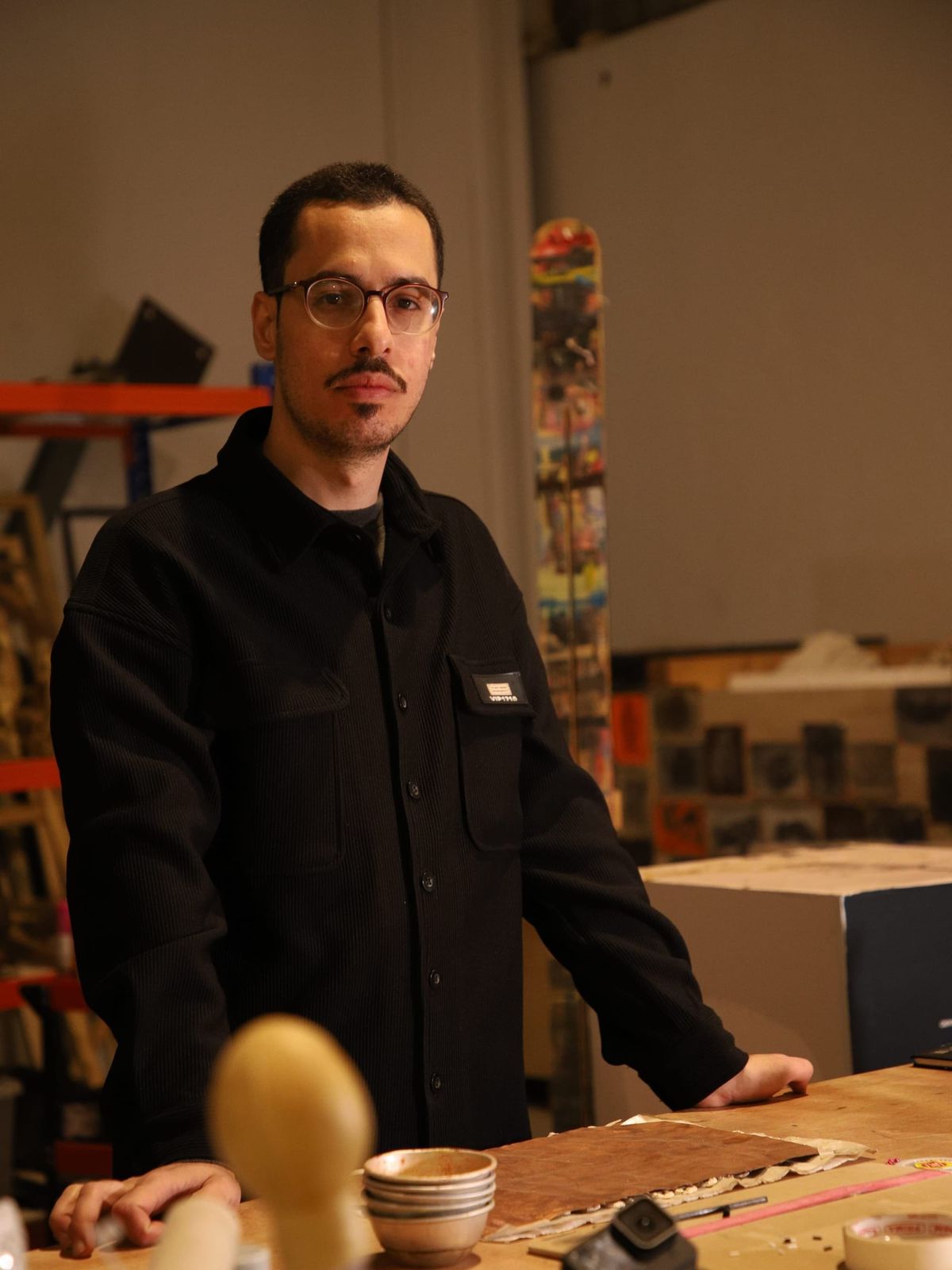
“I always try to stay at zero, in a position where I can engage sufficiently with both sides.”
For Hatem Al Ahmad, that “zero” is not an absence of position. It is a working method. He describes his practice through the image of a number line: positive values on one side, negative values on the other, and himself attempting to remain at the point between them. Rather than beginning with what he personally feels about a subject, he tries to observe it from enough distance to understand the systems, histories, consequences, and relationships around it.
It is an unusually analytical way of describing art. Where artistic practice is often discussed through emotion, intuition, memory, or personal expression, Hatem Al Ahmad deliberately distances himself from those starting points. His work does not, in his words, attempt to communicate his opinions or worldview. Instead, he compares himself to someone assembling a puzzle, arranging existing pieces until their relationships become visible.
That approach has taken him into environmental history, endangered species, desert navigation, archival education films, ecological systems, and historical communication networks. It has also made his background in software engineering unexpectedly central to how he thinks as an artist.
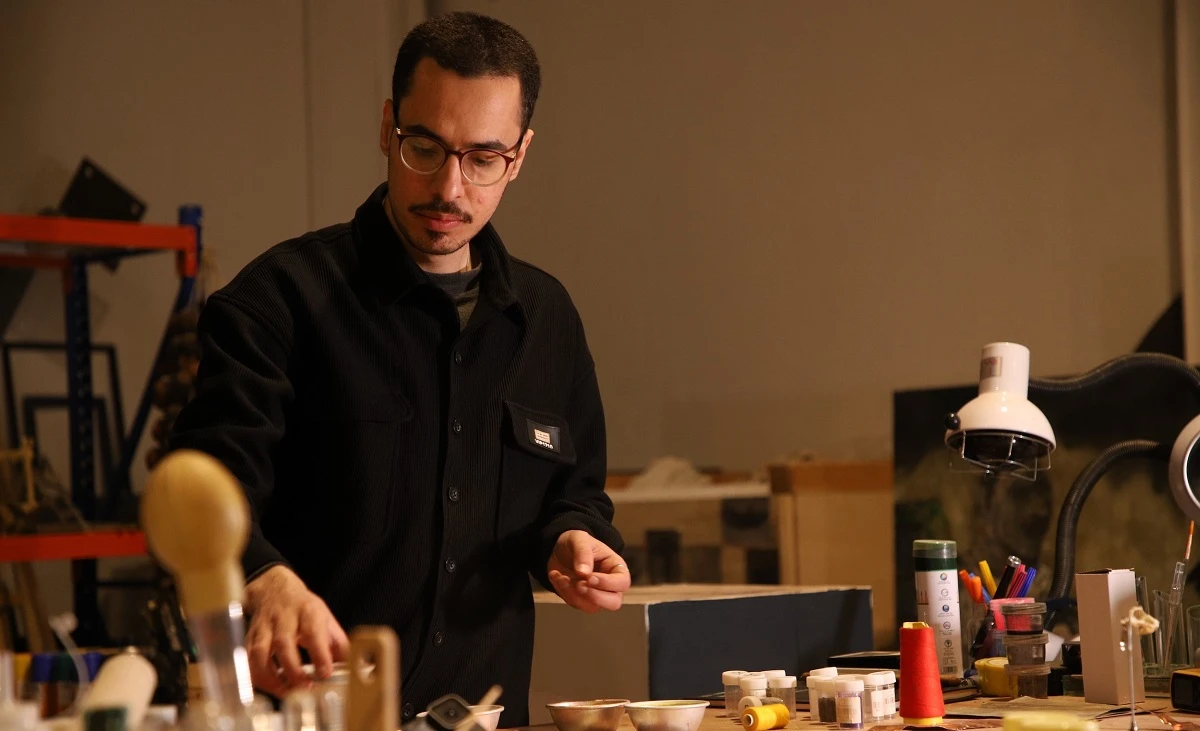
Q: Can you take us back to the beginning of your artistic journey?
Hatem: I grew up surrounded by a wide and changing geography, from mountains and coastal environments to deserts, plains, and other landscapes. Growing up in this place gave me an awareness of the richness of colour that characterises the region.
My actual beginning in art was in 2016, when I was still a teenager. I started at Al Muftaha Arts Village, which was one of the important centres contributing to the artistic community at the time. I began through summer courses, workshops, and local exhibitions. That was really the starting point, and it was based on learning, observation, and experimentation.
Q: How important is Asir to the way you work today?
Hatem: The environment that nurtures my work begins with where I live, the Asir region. I consider Asir an open laboratory. It is a cultural laboratory, an architectural laboratory, an artistic and narrative laboratory. There are myths, colours, and relationships between the wisdom of older generations and the ways they dealt with environmental challenges. All of these become visual and narrative sparks from which a process can begin. An environmental starting point can eventually lead me toward a much more specialised subject.
Hatem Al Ahmad did not follow an academic route into art. His professional background is in software engineering, a field that might initially appear distant from painting or installation. For him, however, the connection is fundamental.
Q: Did you study anything related to art?
Hatem: No. I am actually a software engineer, so professionally I am very far from an academic art background. But I think that affected the way I receive art and the way I approach production as an entire system. In computer engineering and software, everything is connected to logic. Everything follows a particular sequence of steps. There is an algorithm that creates a sequence of events within code or a program. That has been reflected in my art.
My artistic practice depends on using logic as a tool for constructing a visual narrative. Because of that, my personal commentary, opinions, or even emotional attachment to the work can be almost absent. The work becomes an algorithm that begins at one point and ends at another point, which is the final artwork.
Q: Are there particular materials you return to?
Hatem: The main material I am known for is the brush and paint, particularly expressive painting connected to environmental contexts and environmental concerns. My practice is also connected to the relationship between the human being of the past and the human being of the future, almost bypassing the present. I study the past and attempt to read the future through different media. That includes painting, engraving, printmaking, archival works, and installation. Installation now occupies almost half of my practice.
I would describe myself as a multidisciplinary artist. I may be known for painting, but that does not restrict me to one direction. The project determines what it needs, and the most suitable tool leads the practice, not the other way around.
Q: Is there a visual element that repeatedly appears in your work?
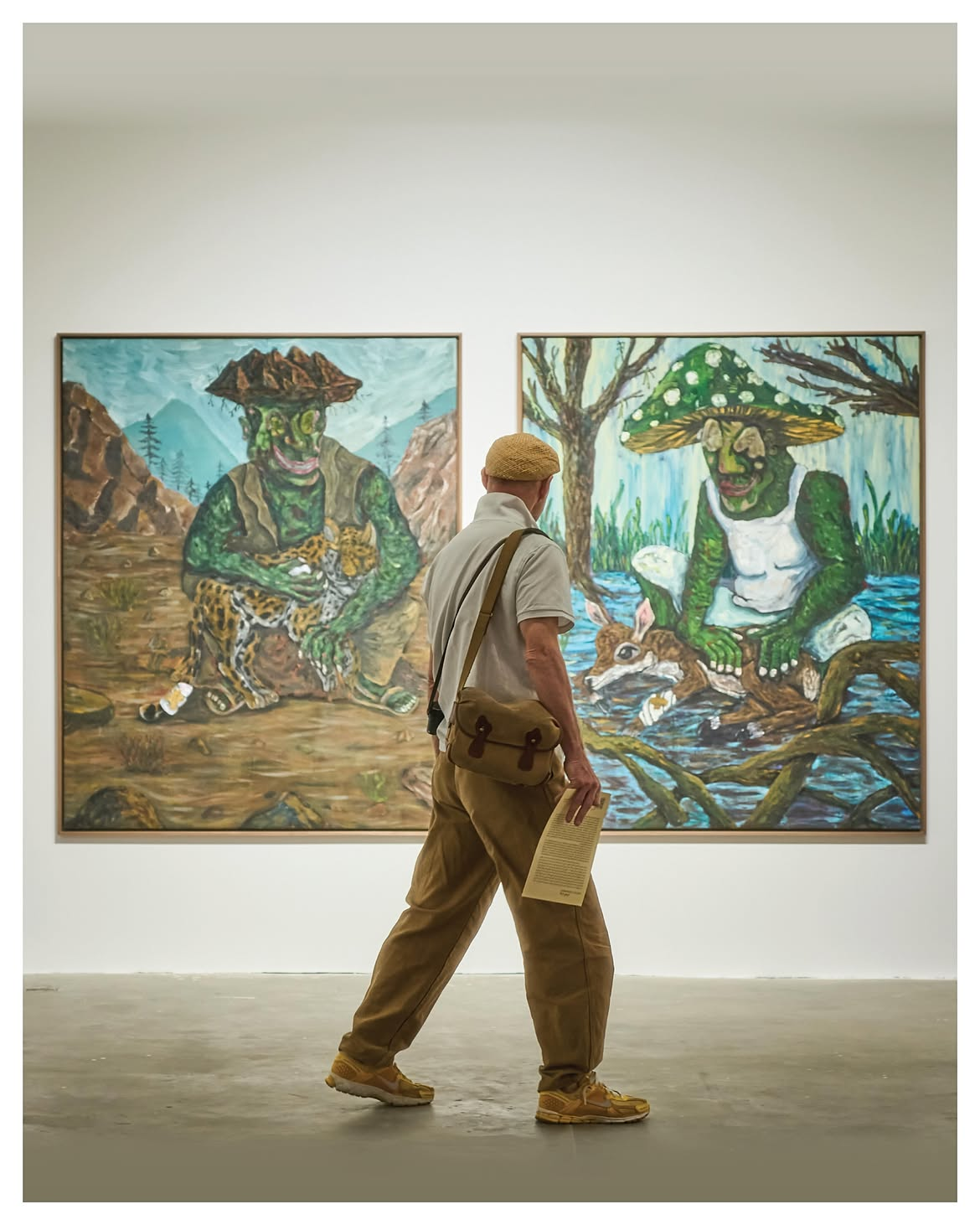
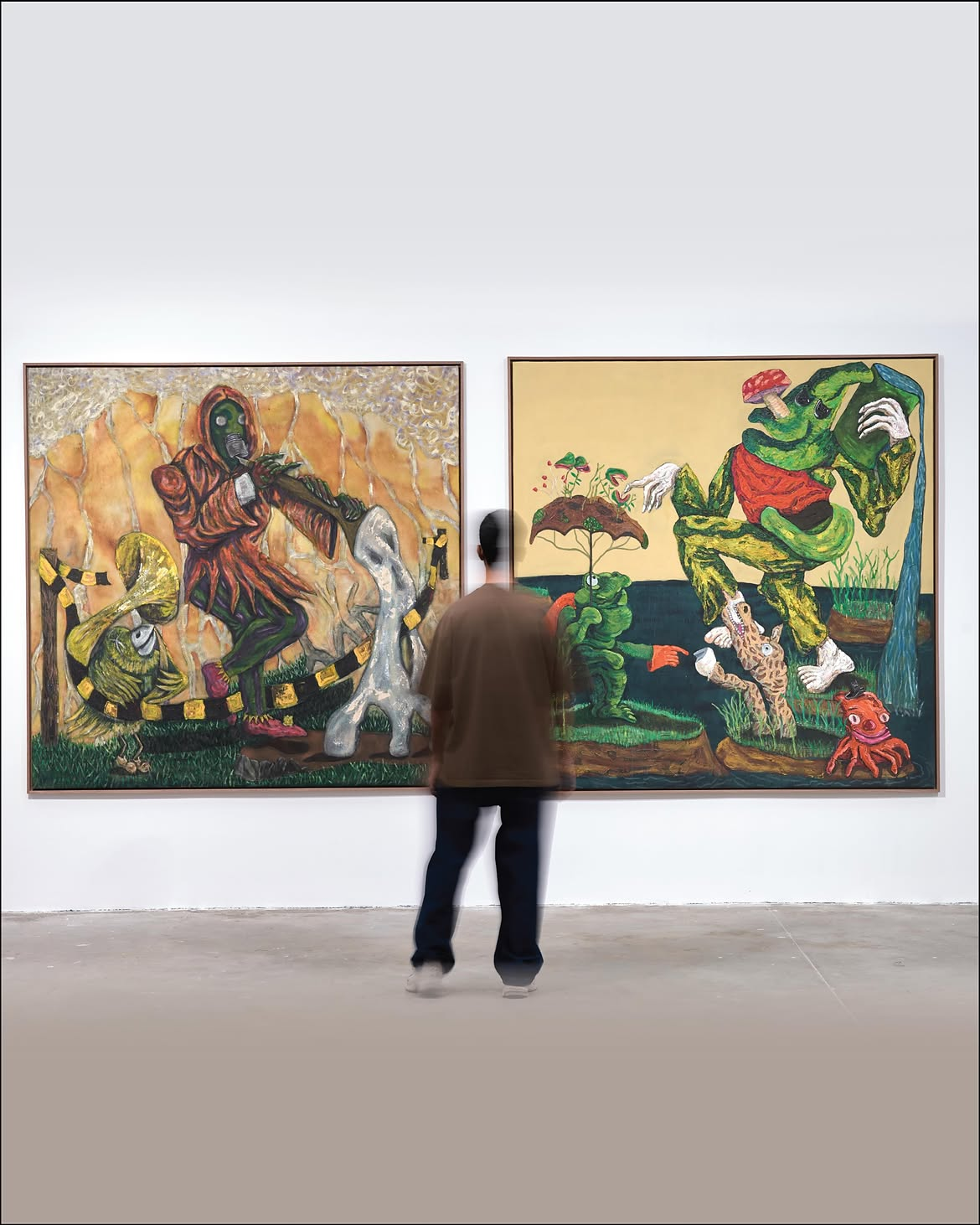
Hatem: There are certain visual elements. I would not necessarily say they are repeated, but I give them particular functions within the work. One element that appears frequently is the human figure. I often use the human figure as the structure onto which I build the subjects I am addressing. So there is the human first, and then the life surrounding that person. My work often depends on the relationship between human and non-human life. That brings in plants, animals, and other forms of life.
In my exhibition Sensitivity of Ruins, for example, there were different species of fungi that absorb radiation from contaminated environments, algae, amphibians such as frogs, birds such as crows, and local animals including gazelles and the Arabian leopard. There were also animals that once existed within the region but have disappeared from the contemporary landscape. The visual language I am known for is often a hybrid between human life and non-human life.
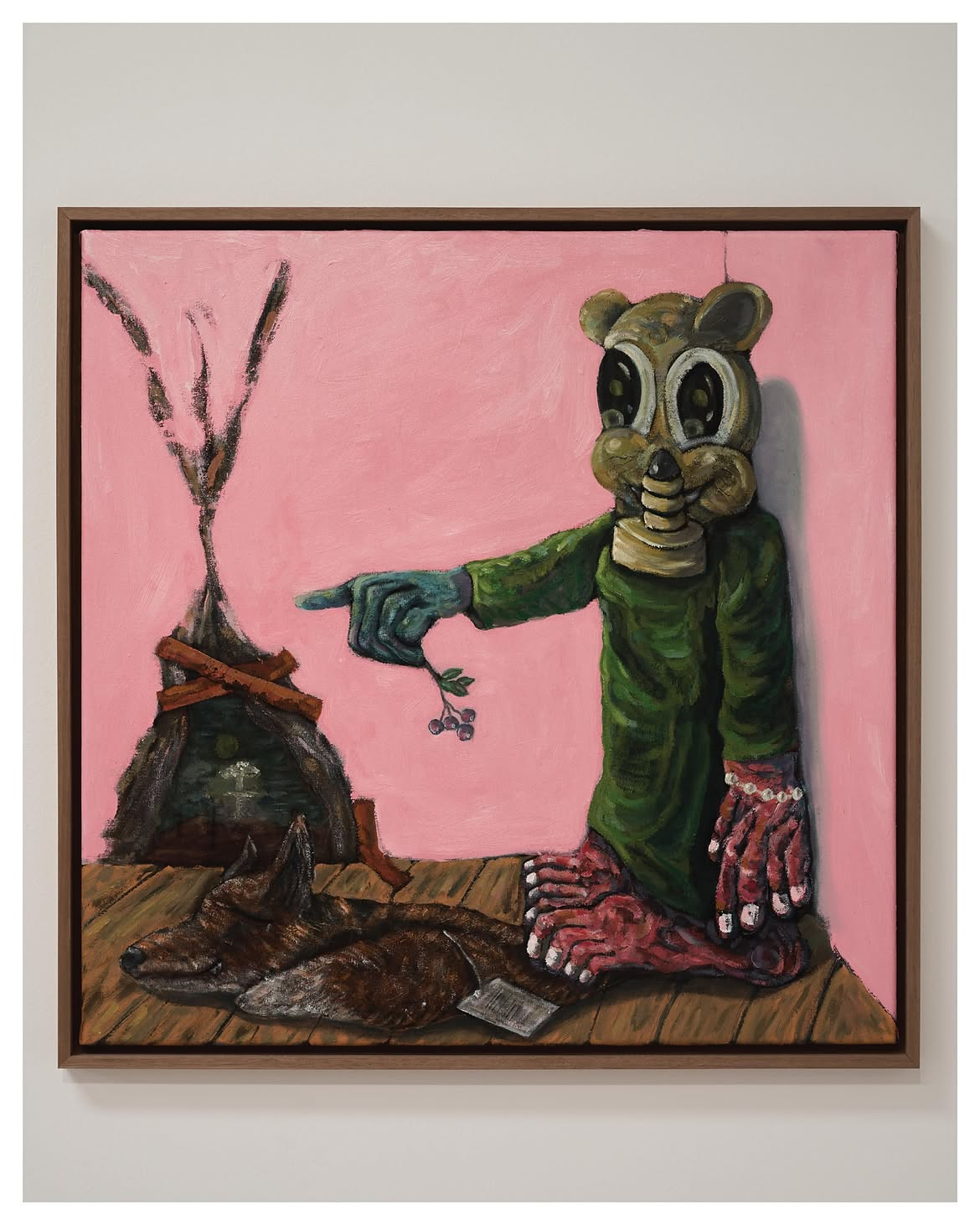
Hatem Al Ahmad’s environmental focus does not function as a conventional call to action. He is careful about the distinction. Rather than instructing the viewer how to feel, or presenting himself as the emotional centre of the work, he is interested in showing a condition, tracing where it came from, and asking where it could lead.
Q: Why do environmental subjects continue to lead your practice?
Hatem: I see environmental issues as questions that are more universal than questions concerning me personally as an artist. I do not have an emotional relationship with my works. My works do not reflect my personal opinions or my personal view of the world. I can compare myself to someone who has a puzzle and simply arranges the pieces in the logical order in which they are supposed to appear.
That is why my subjects focus on things such as the human footprint on the planet, pollution, global warming, biopiracy, the future, and water. These subjects lead my practice rather than me controlling them.
Q: What do you want the audience to feel when they encounter your work?
Hatem: My work is not connected to emotional storytelling. Especially when dealing with the environment, I do not rely on motivation or on trying to directly change people. I simply highlight something that happened in the past and explore its consequences for the future.
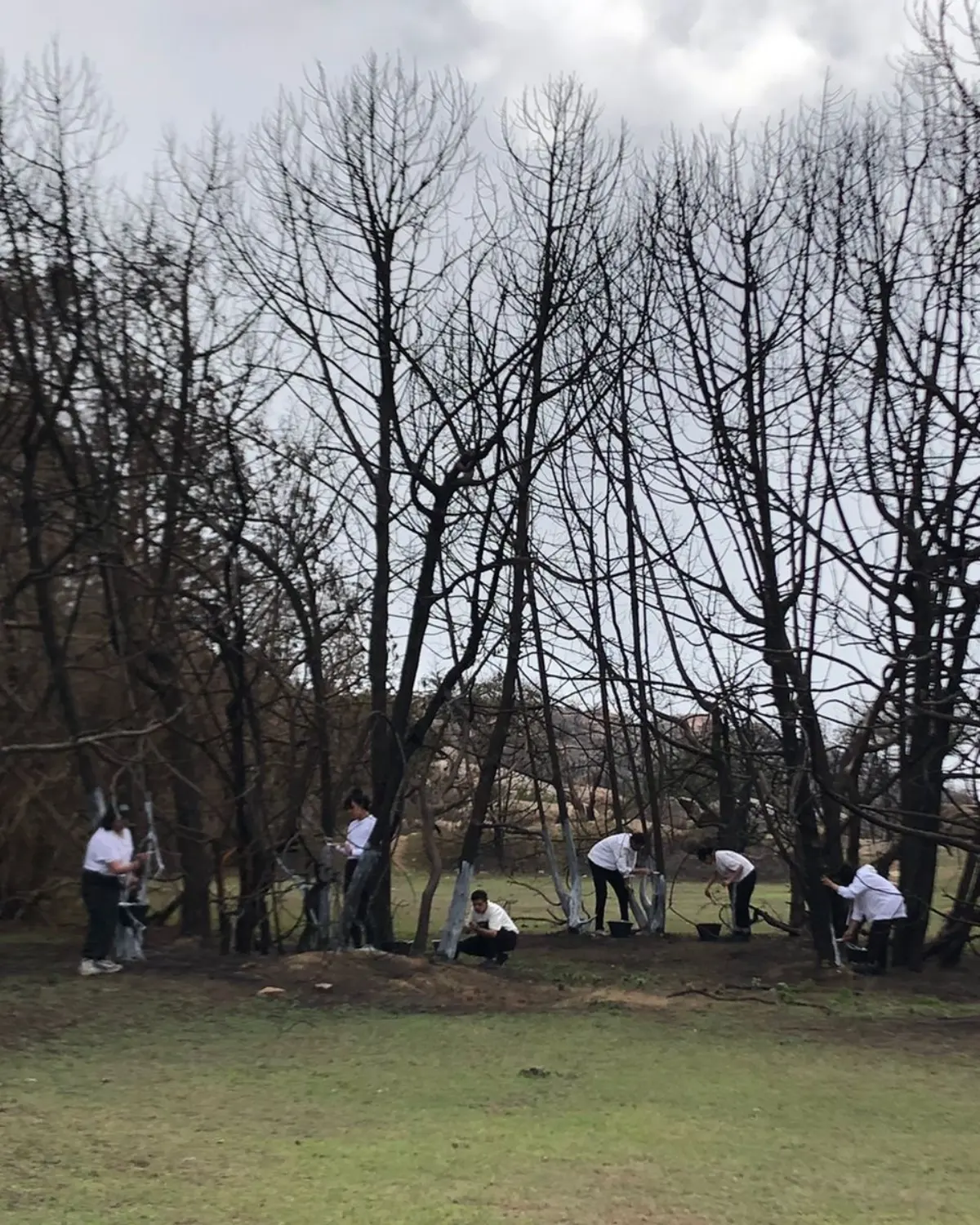
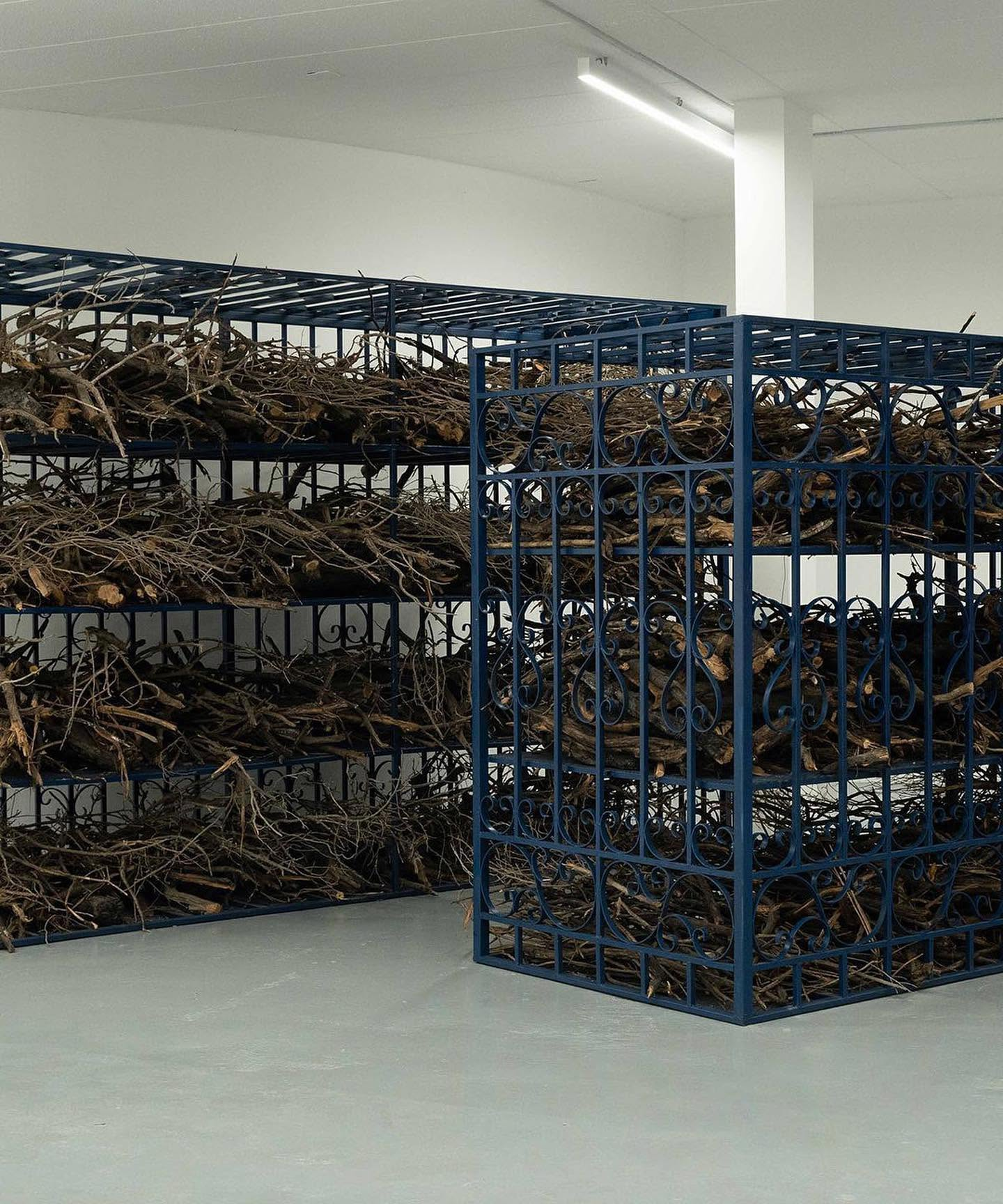
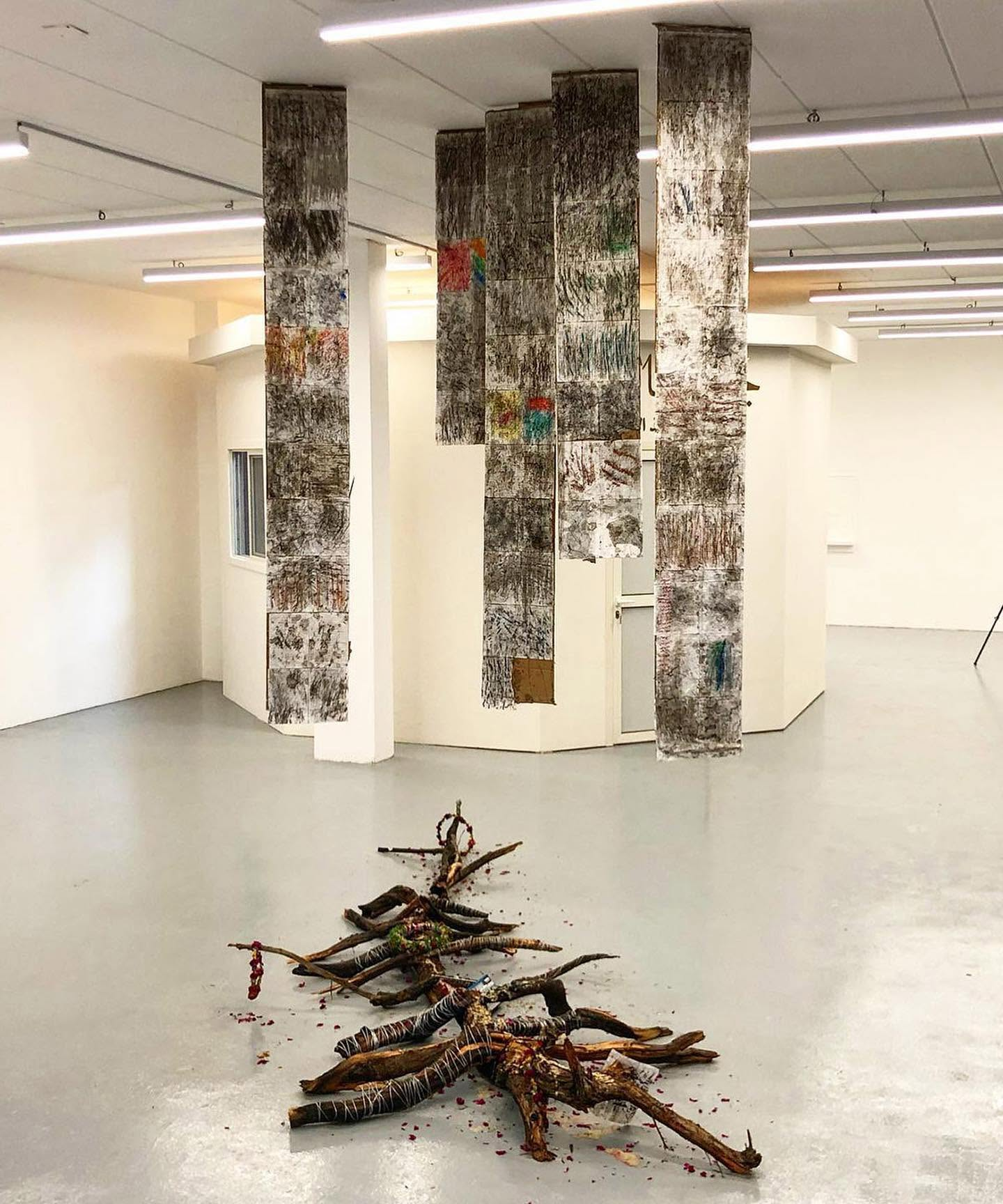
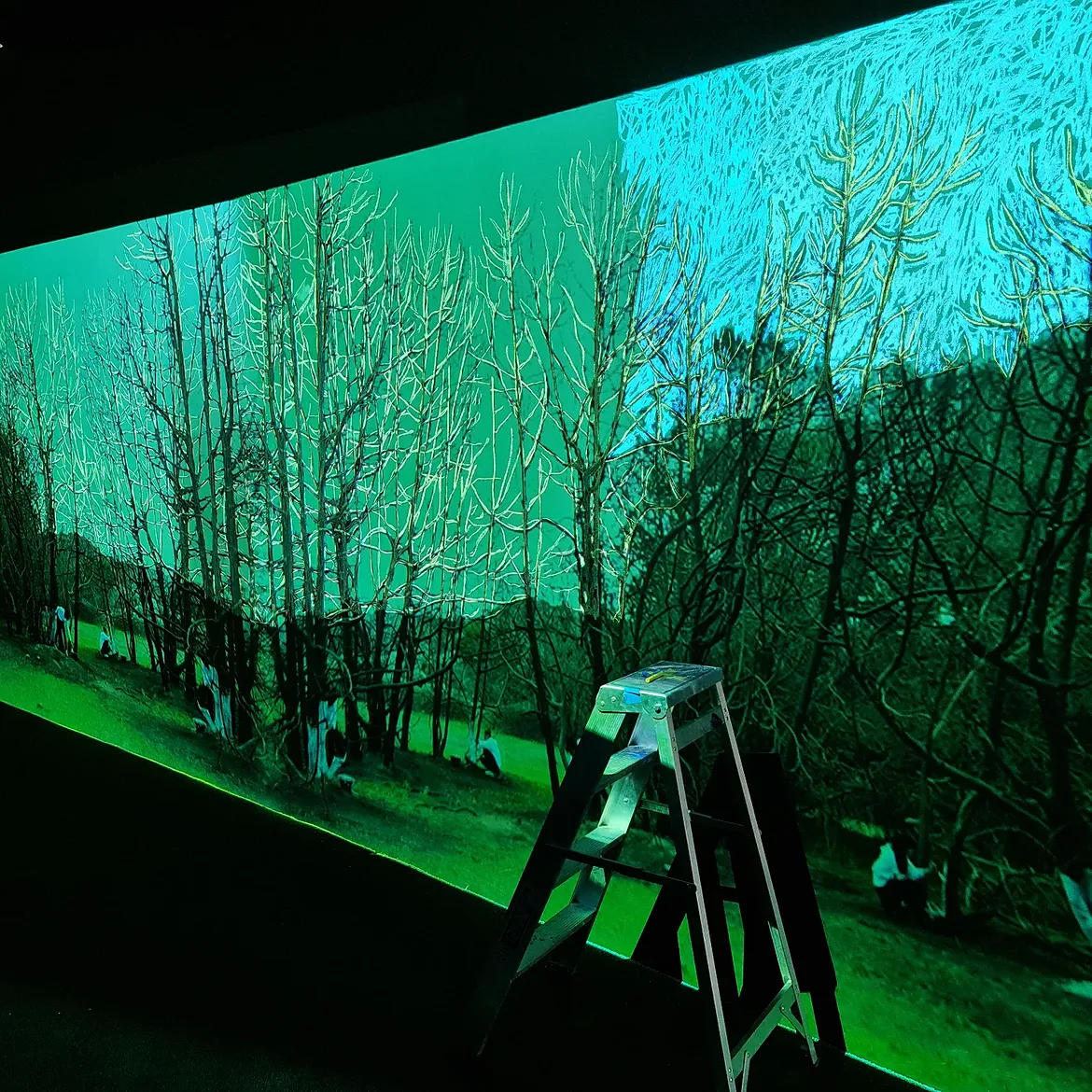
Find Me Through the Fog, Hatem Al Ahmad’s project responding to the 2020 Abha forest fires, exploring damaged landscapes, tree recovery, and environmental care through fieldwork and installation.
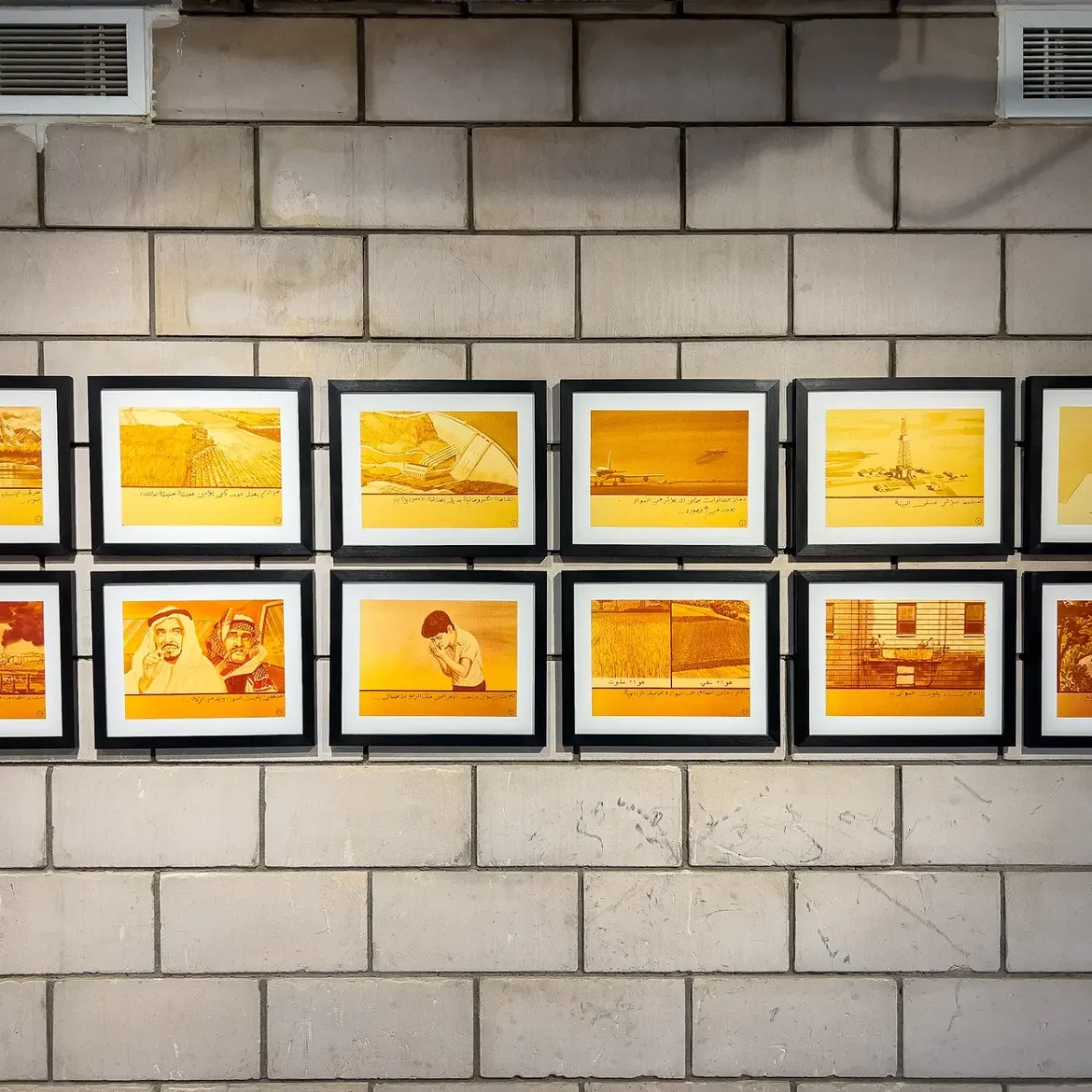
One of the clearest examples of Hatem Al Ahmad’s method began with an educational filmstrip produced decades ago. Rather than simply presenting the archival object, he used it to test what had changed between generations.
Q: How have archival materials entered your practice?
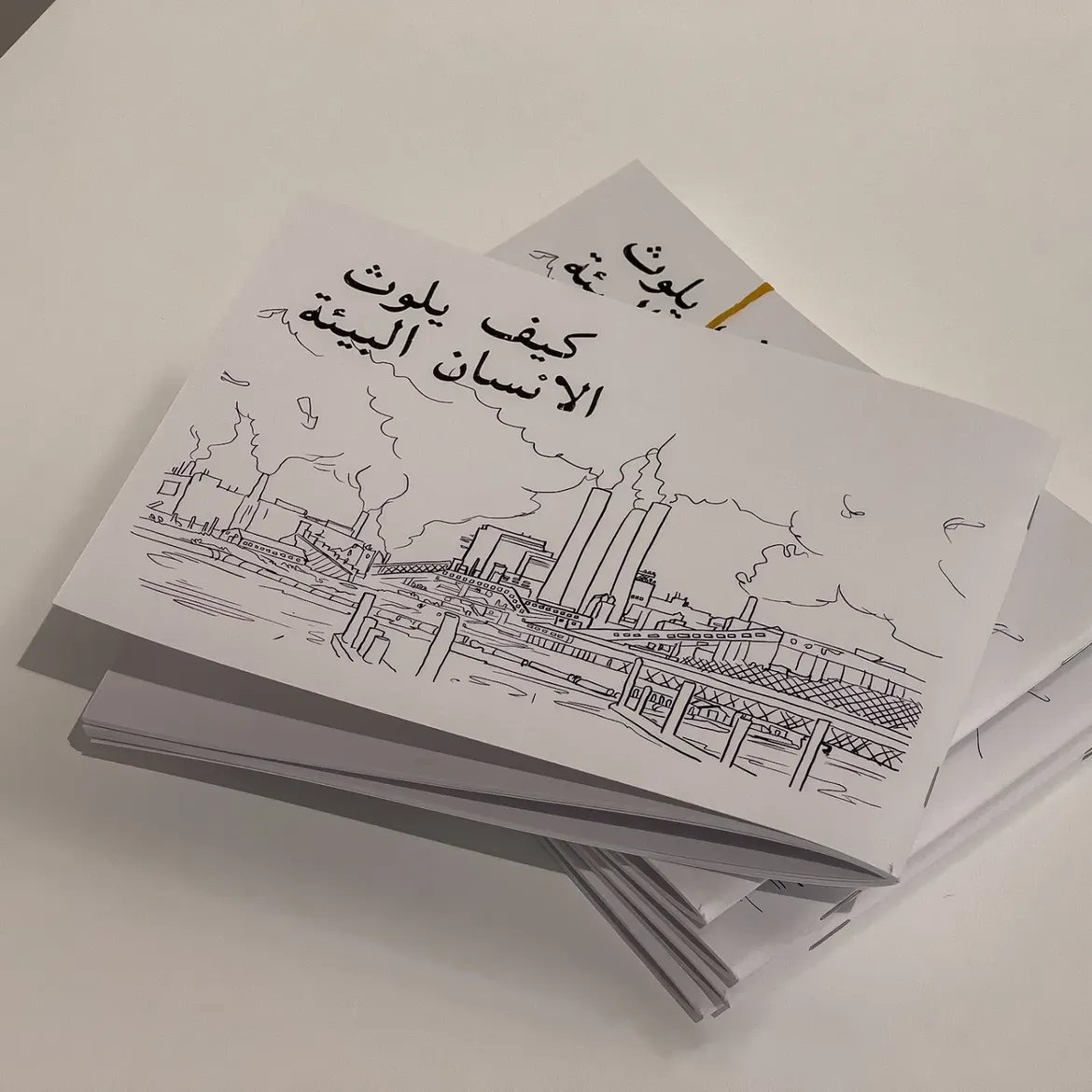
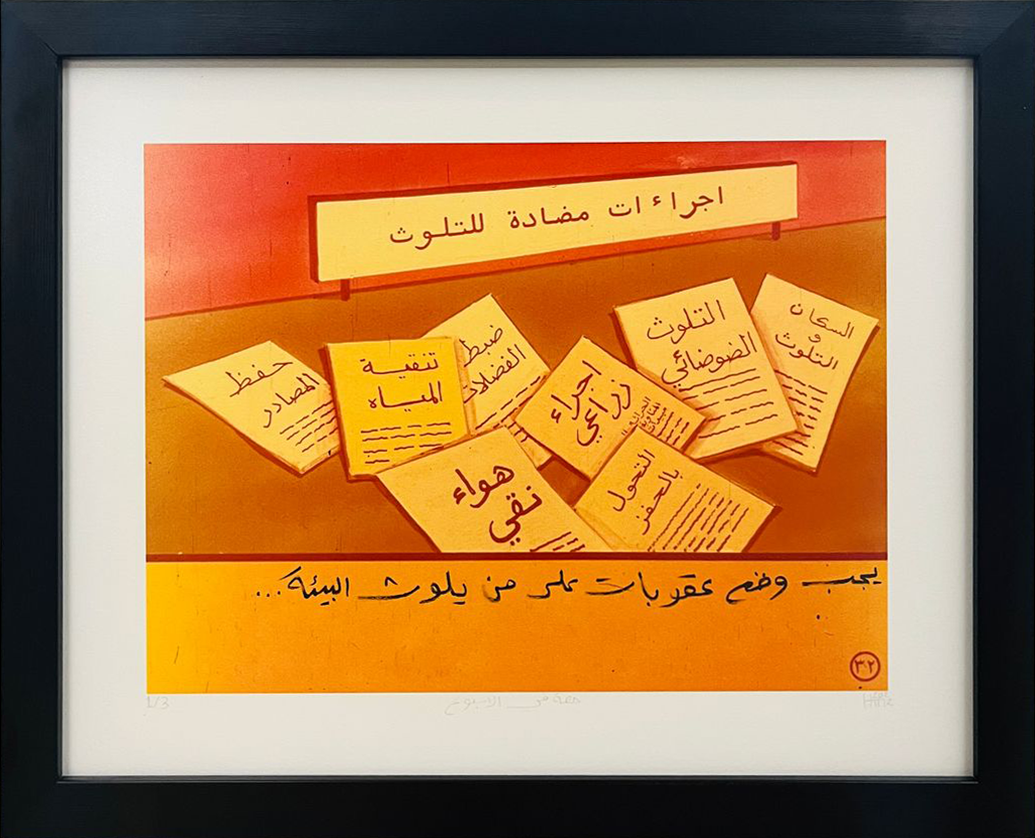
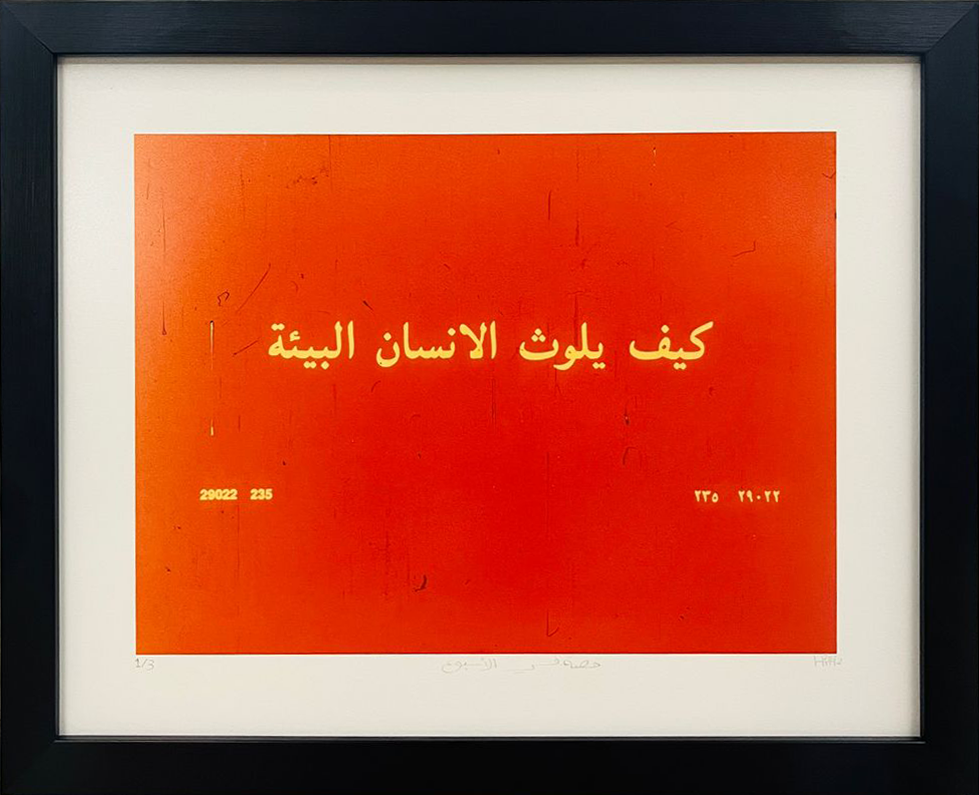
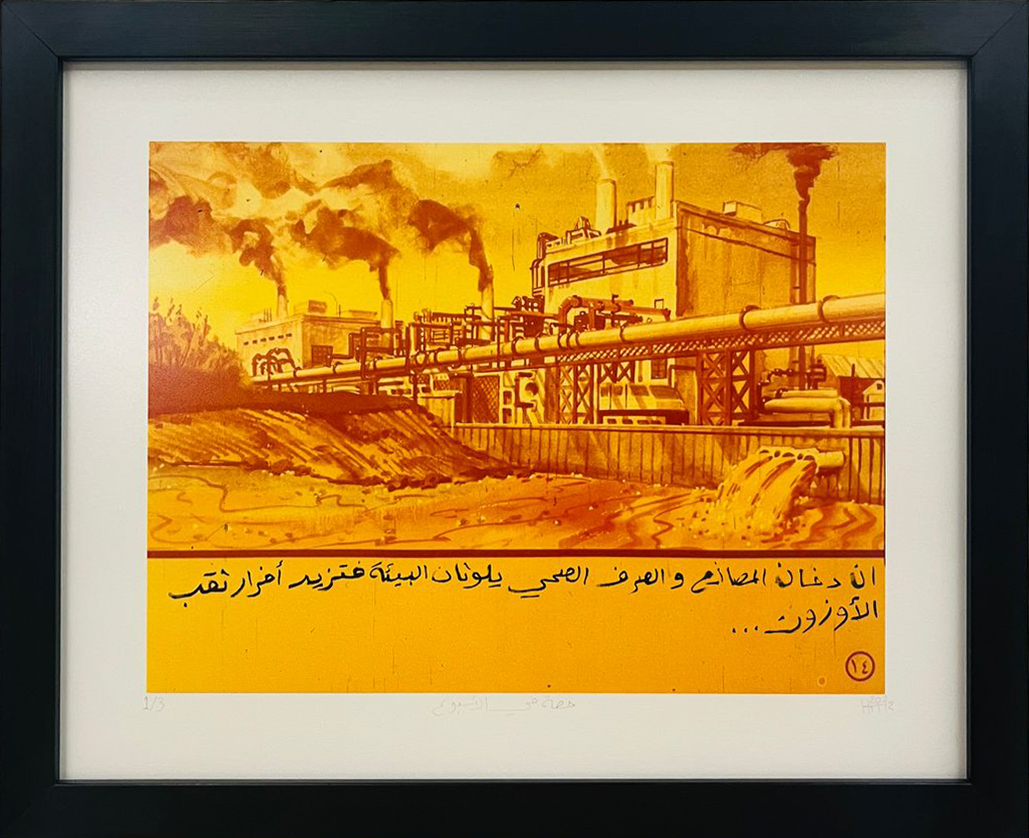
Hatem: I acquired an educational scientific resource originally produced by the former Ministry of Knowledge, which was the earlier name of today’s Ministry of Education. It was a 35mm filmstrip called How Humans Pollute the Environment. It dated back to approximately the 1960s or 1970s.
In my project, I preserved the visual content but removed the explanatory text from each slide. I then invited younger generations to write new environmental observations about the images. The project consisted of 47 archival prints.
It connected the context of this old educational material to children today, who are essentially the generation moving toward the future. Unfortunately, I discovered that the environmental concerns that existed in the 1960s are still being carried by children today. I think they may become the capsules that carry those same environmental concerns into the future.
In Dream of Wakefulness, Hatem Al Ahmad approached ecological balance through geography. Historical maps became the basis of an installation examining the Arabian leopard’s former range and the changing relationship between humans and the species around them.
Q: Can you tell us about Dream of Wakefulness?
Hatem: The project was concerned with ecological balance in the Arabian Gulf, although I would not restrict it to one particular location. It focused on the Arabian leopard. I worked with maps showing the historical geographical distribution of the Arabian leopard, beginning from the edges of the UAE, through Oman and Yemen, extending into areas approaching Riyadh, and reaching as far as Sinai and Jordan.
This entire geographical area was once habitat for the Arabian leopard. And it was not only the leopard. There were also large populations of Arabian ostriches associated with the landscapes of the Arabian desert. We do not normally imagine these animals existing in such large numbers.
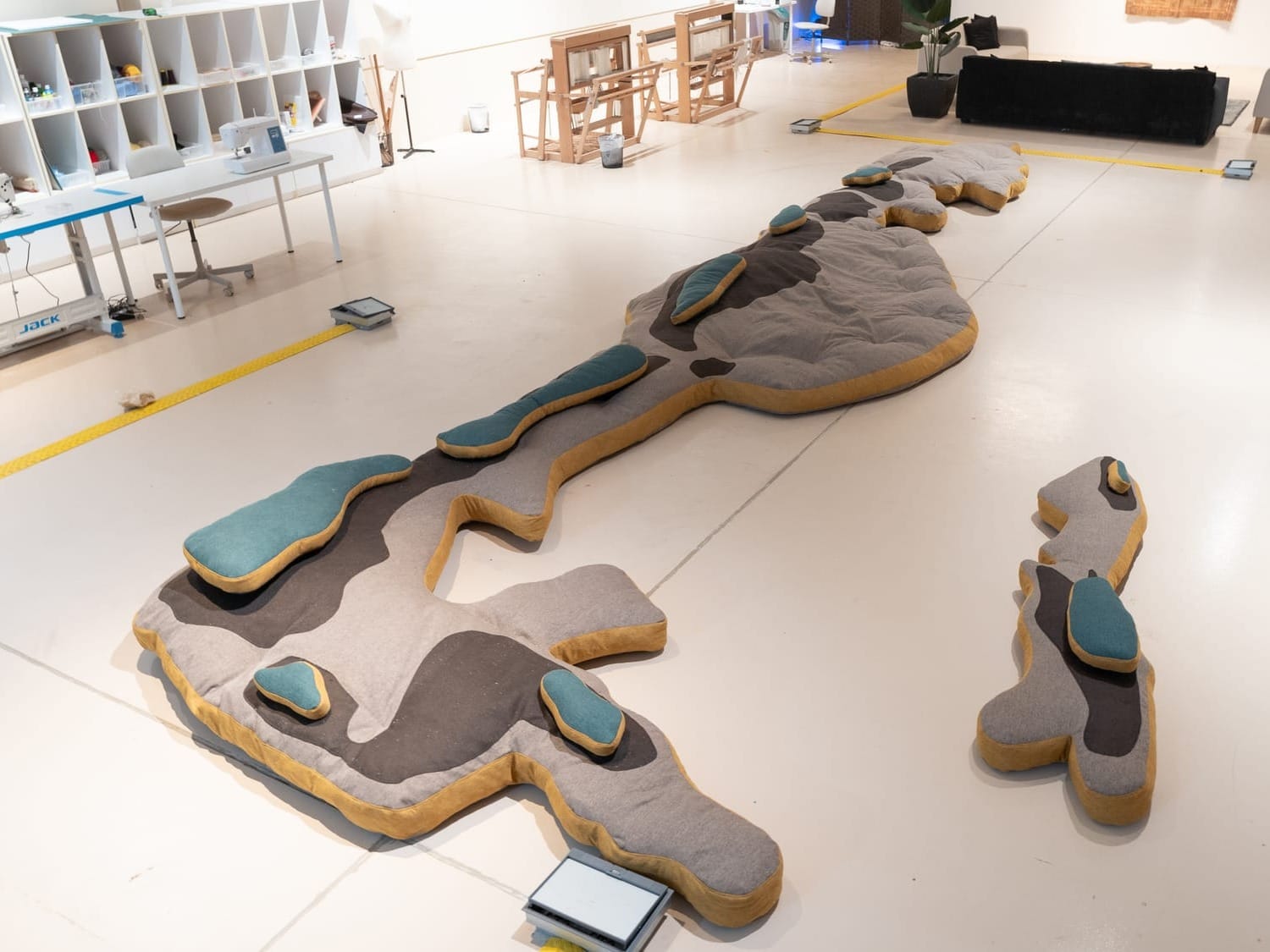
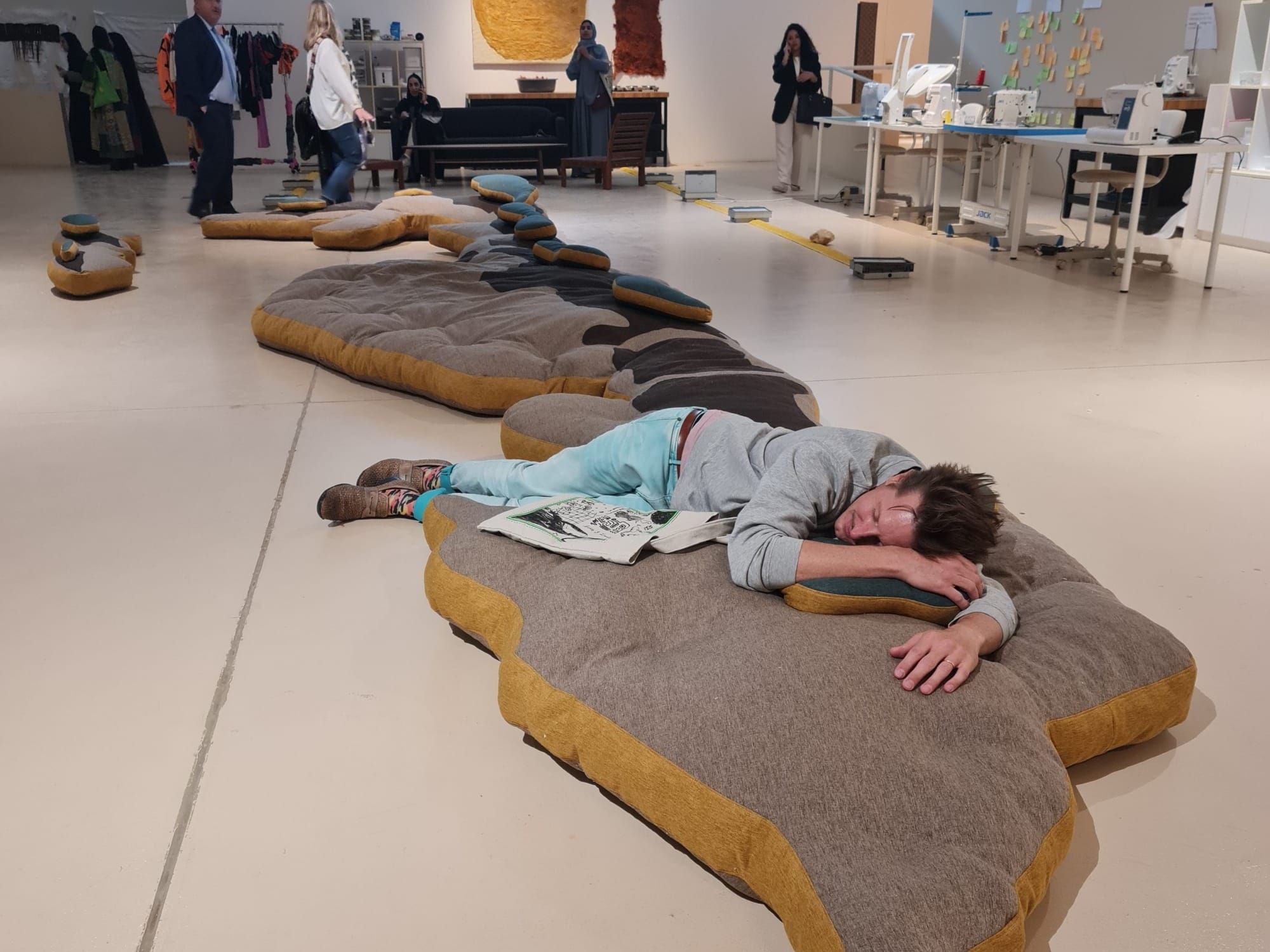
I developed an algorithm through which I interpreted how the distribution of the Arabian leopard changed from one historical period to another. I then transformed that map into a resting space. I reproduced the geography itself as an interactive environment, almost like a cushion or resting place that people could physically interact with.
It reflected the possibility of humans coexisting within the territory of this animal. The Arabian leopard is a fundamental participant in the ecological balance and food chain of the region. There are now very positive efforts to reintroduce the Arabian leopard. That was one of the first sparks that led me to engage with these kinds of subjects.
For Still From Here, created with PHI Studio co-founder Saeed Jabaan for Noor Riyadh, the starting point was another form of knowledge: the ways people once navigated landscapes without permanent landmarks.
Q: What was the idea behind Still From Here?
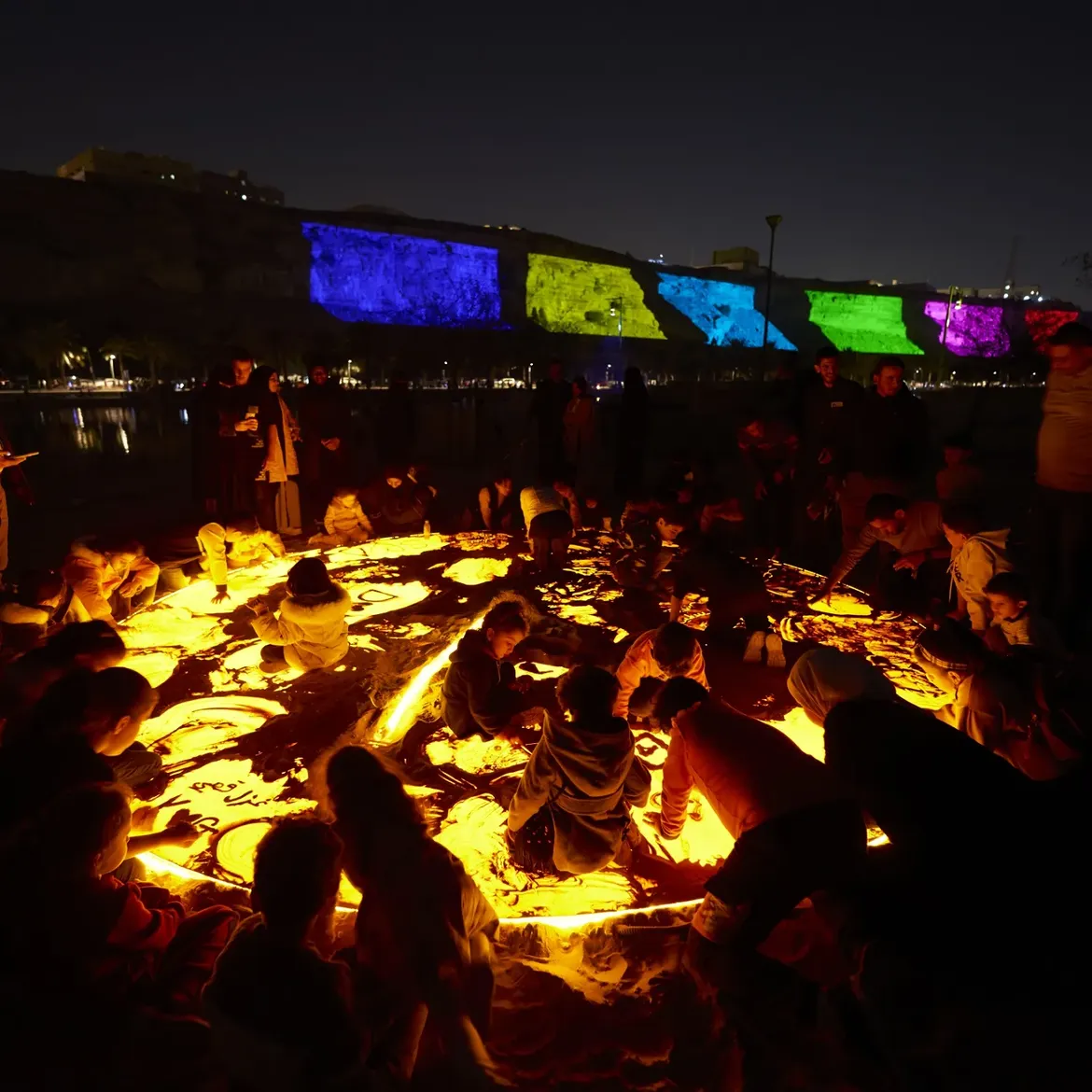
Hatem: Still From Here was a collaborative work between me and my partner, Saeed Jabaan. We are the two founders of PHI Studio, which is concerned with developing artistic knowledge and contemporary practices in the region. We worked on Still From Here for Noor Riyadh in Wadi Namar.
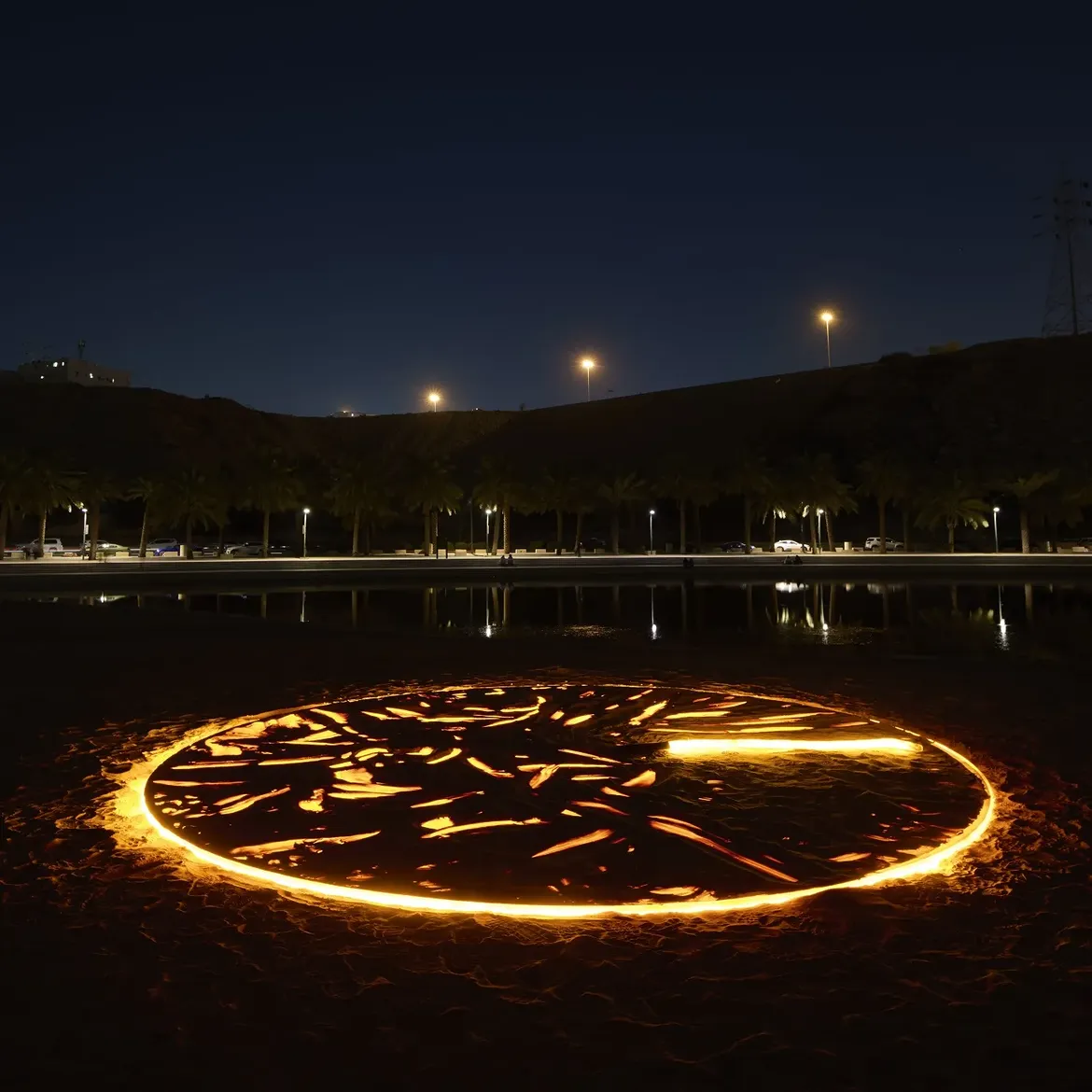
The project created an interaction between light and sand through a circle. The circle referred to a practice once used during nighttime travel and navigation in the desert. Among some desert travellers, there was a practice of drawing a circle around the place where the traveller would sleep. The traveller would then point the staff they were carrying toward the direction they intended to continue travelling in.
The desert does not have permanent landmarks that you can always navigate by because it is constantly changing. The staff effectively preserved the direction. Through the circle, we created a particular form of lighting that interacted with the sand covering it. Inside the space, visitors could interact with the work and draw different forms through the sand.
Historical systems return again in Winged Echoes, developed through a Misk grant. This time, the subject was not ecology but communication.
Q: What was the starting point for Winged Echoes?
Hatem: The project came from a grant I received from Misk. The theme was related to methods of communication and the way they can shape the past or future of civilizations. I researched one of the important communication systems developed within Islamic civilization: carrier pigeons. Through archival research, I discovered that there had been a highly organised communications network.
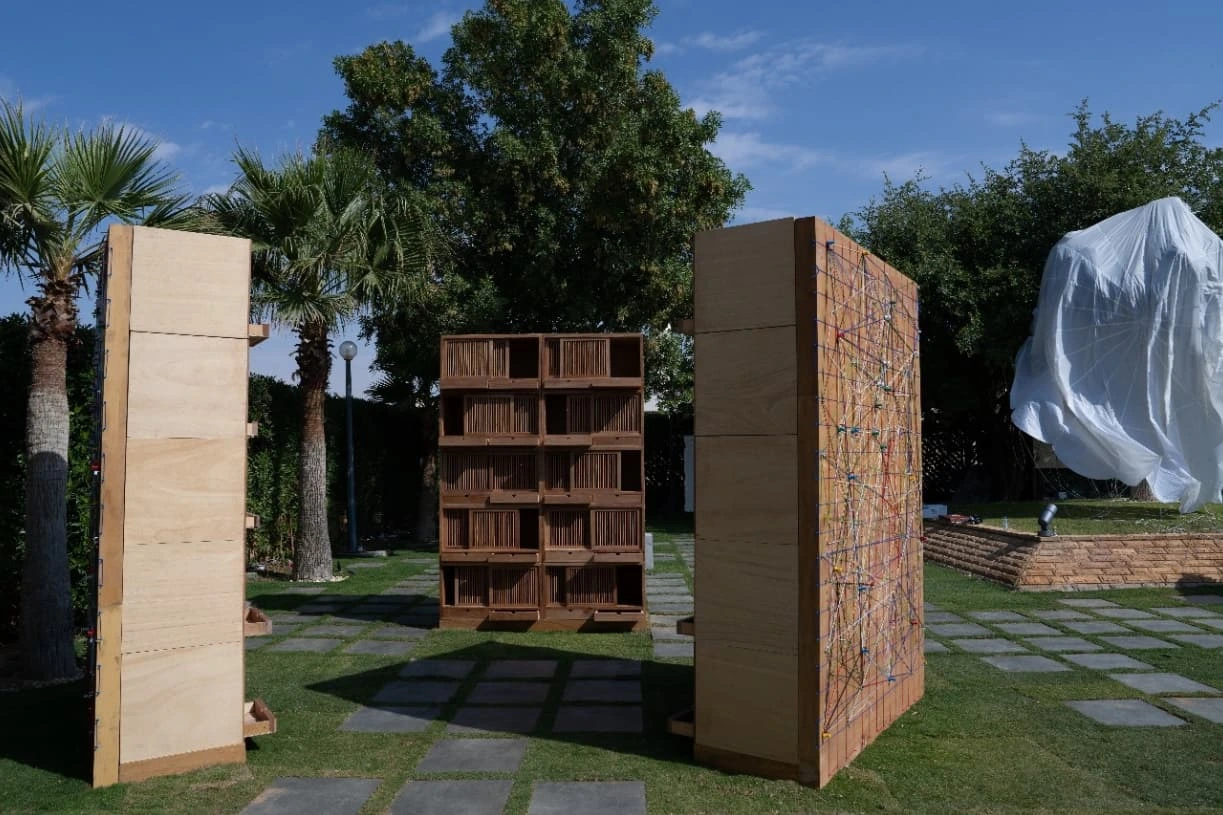
There was a dedicated administrative body responsible for communications, connecting an entire civilization. I worked on reconstructing the pigeon houses or stations and the ways the birds were arranged and managed within each station. Using archival materials documenting journeys between different stations, we also created an audio narrative.
There were three towers representing the organisation and movement of the pigeons, alongside a map produced through a method similar to topographic illustration using thread and pins. The map became a visual reflection of the audio narrative.
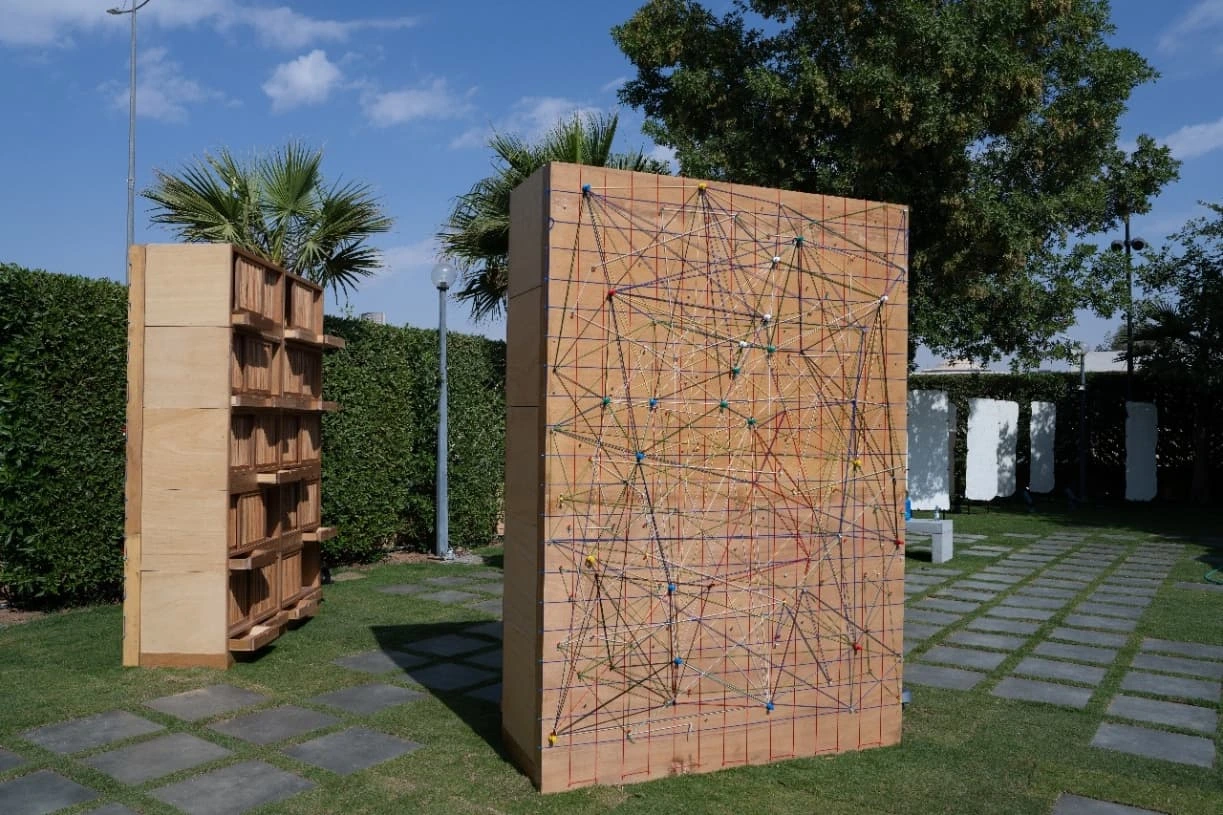
If Hatem Al Ahmad’s finished works can appear dramatically different from one another, the method underneath them is remarkably consistent. Each begins with a question. That question branches into research, reading, archives, conversations, and other forms of investigation until a visual structure begins to emerge.
Q: How do you know when an artwork is ready?
Hatem: There is something I always require from myself. I do not want any step in the process to depend on improvisation or on an emotional impulse. My works are based on an algorithmic structure. They begin with a question, proposition, or concept. Then that branches into different paths, and eventually those branches reach a final result.
This takes the form of files, readings, research, and other materials, which ultimately become an image or are translated into a visual form. Once the research phase is complete, the execution becomes almost inevitable. Execution is simply the visual assembly of everything that came before it.
Q: Is there a point where you know the research itself is complete?
Hatem: For me, the work needs to cover two main questions. First: where have humans reached in their interaction with this event, idea, or concept? Second: what could its impact be in the future? Once I feel I have covered those two points, the work is complete for me.
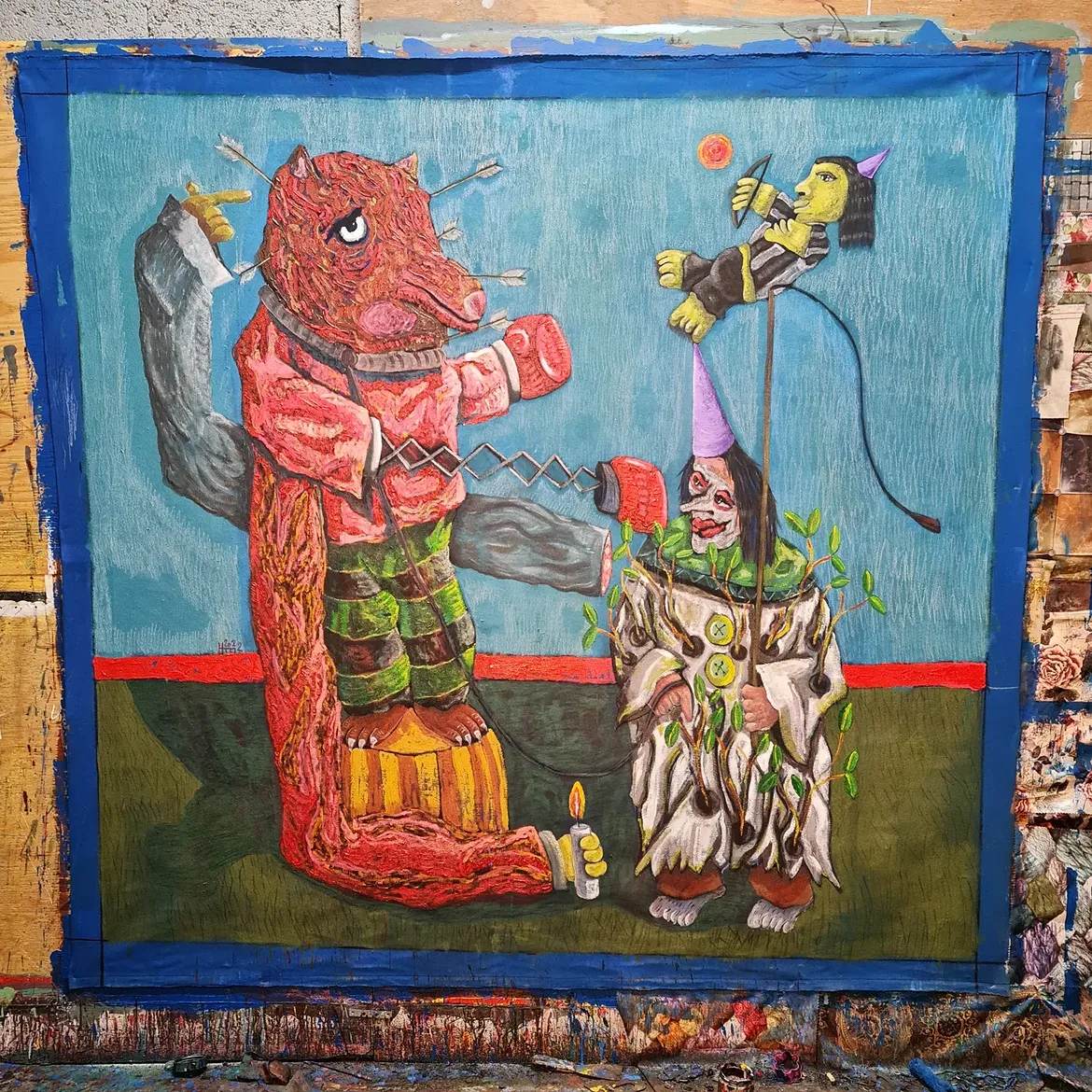
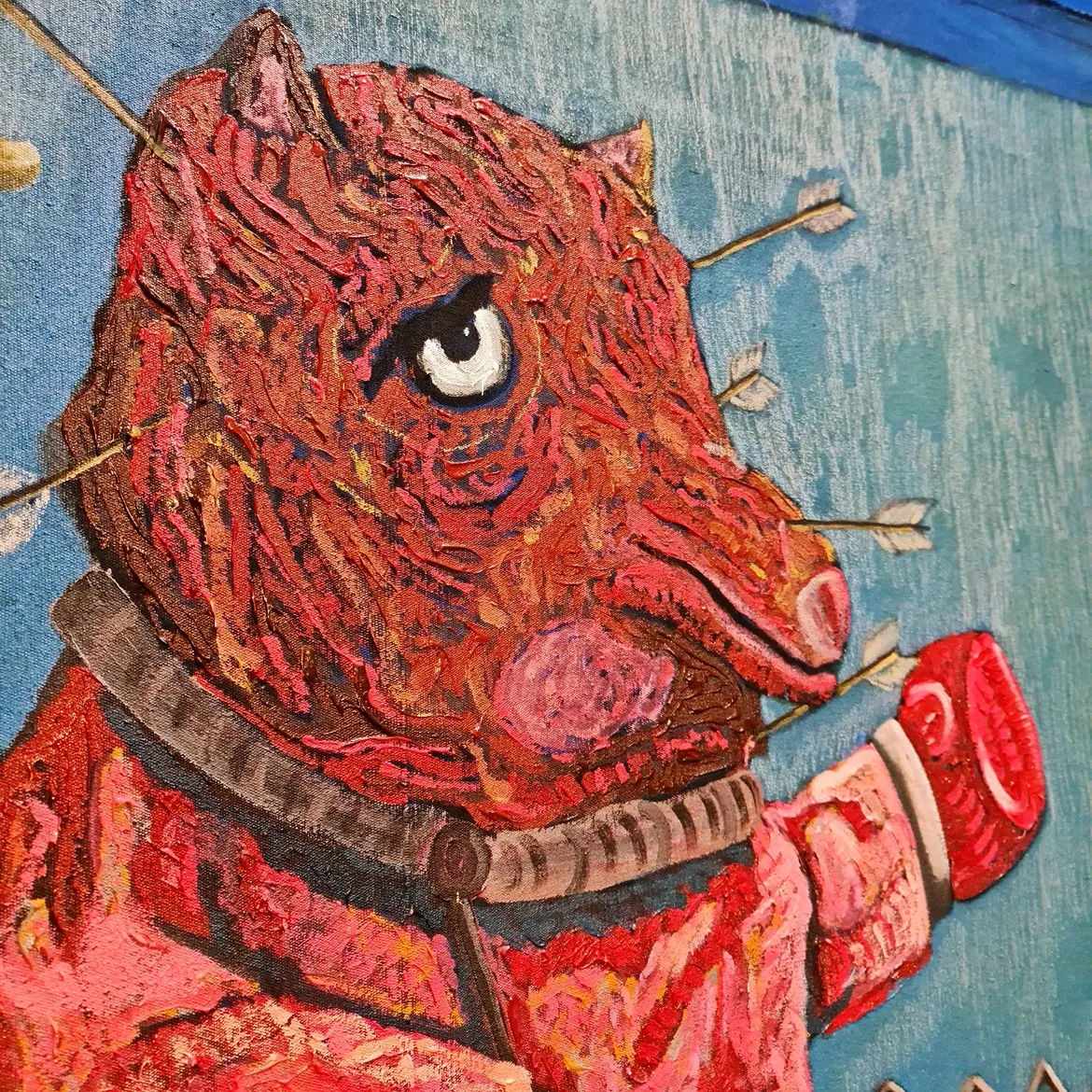
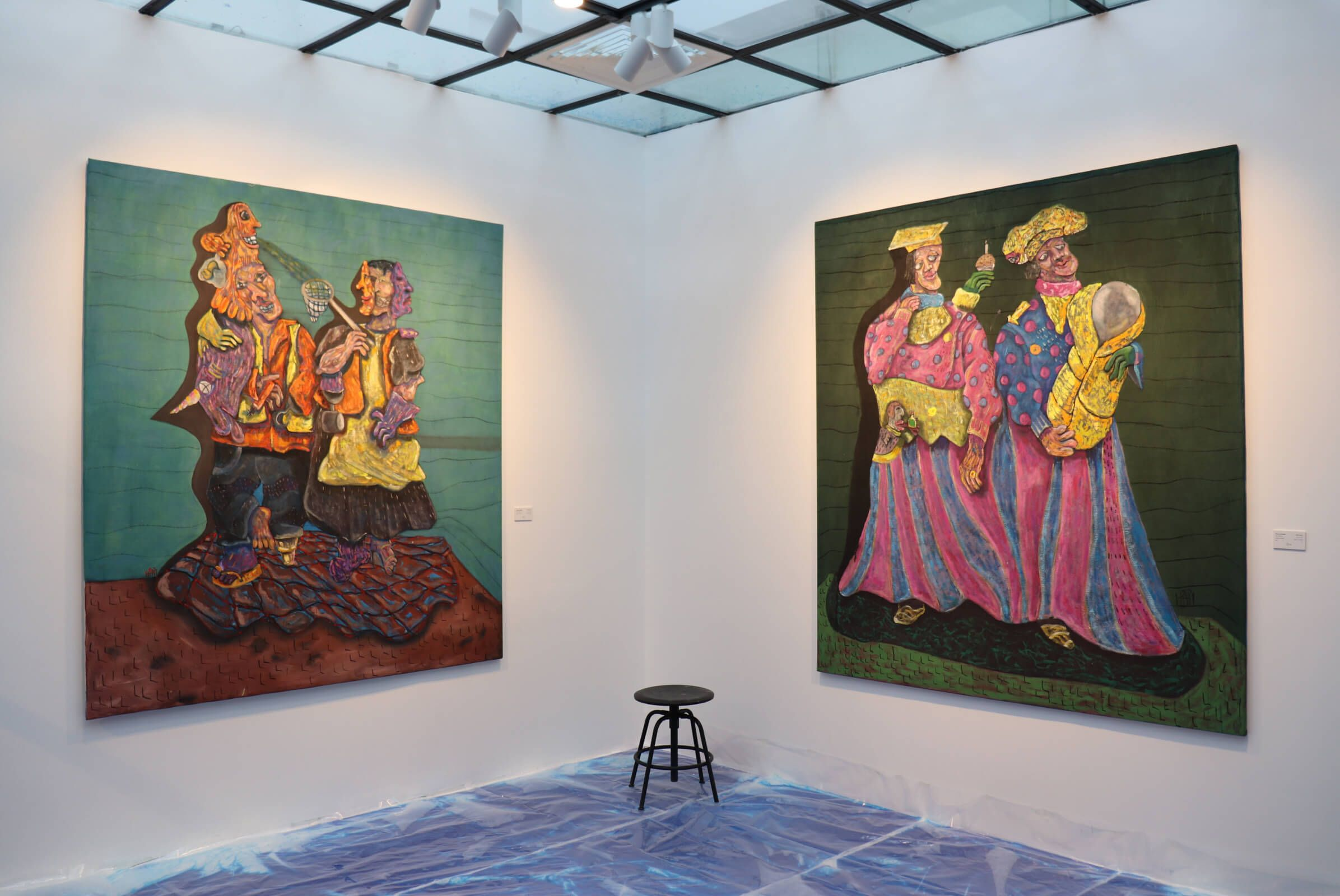
Theatrical Indicators (2022) by Hatem Al Ahmad, a large blue figurative painting combining exaggerated human and animal-like characters, plants, and surreal forms within an ambiguous theatrical scene.
Q: Is there one artwork that feels closest to you personally?
Hatem: Honestly, I do not have one work that is particularly close to me. As I mentioned, neutrality is what guides the overall practice. Each of my projects belongs to a particular process of research, execution, and investigation, so I do not have a favourite work.
If I were to describe my practice, or the responsibility I feel toward my works, I would compare it to a number line. You have positive numbers and negative numbers, and I always try to stay at zero, in a position where I can engage sufficiently with both sides. That allows me to maintain a wider view rather than an extremely narrow or microscopic one.
Q: How would you like your artistic practice to develop in the future?
Hatem: One of my ambitions is for my work to move beyond what we might call the handmade or manual aspect and become even more research-based. One goal would be to have access to better laboratory environments in which certain elements of my practice could be explored. I would also like broader access to libraries and resources covering the fields I am interested in.
I hope there can be greater collaboration between my artistic work and scientific institutions working within the same areas. To be honest, there is still a shortage of Arabic environmental resources in general. At the same time, I feel the direction of my work respects its local foundations while still addressing broader global subjects. I do not think one contradicts the other.
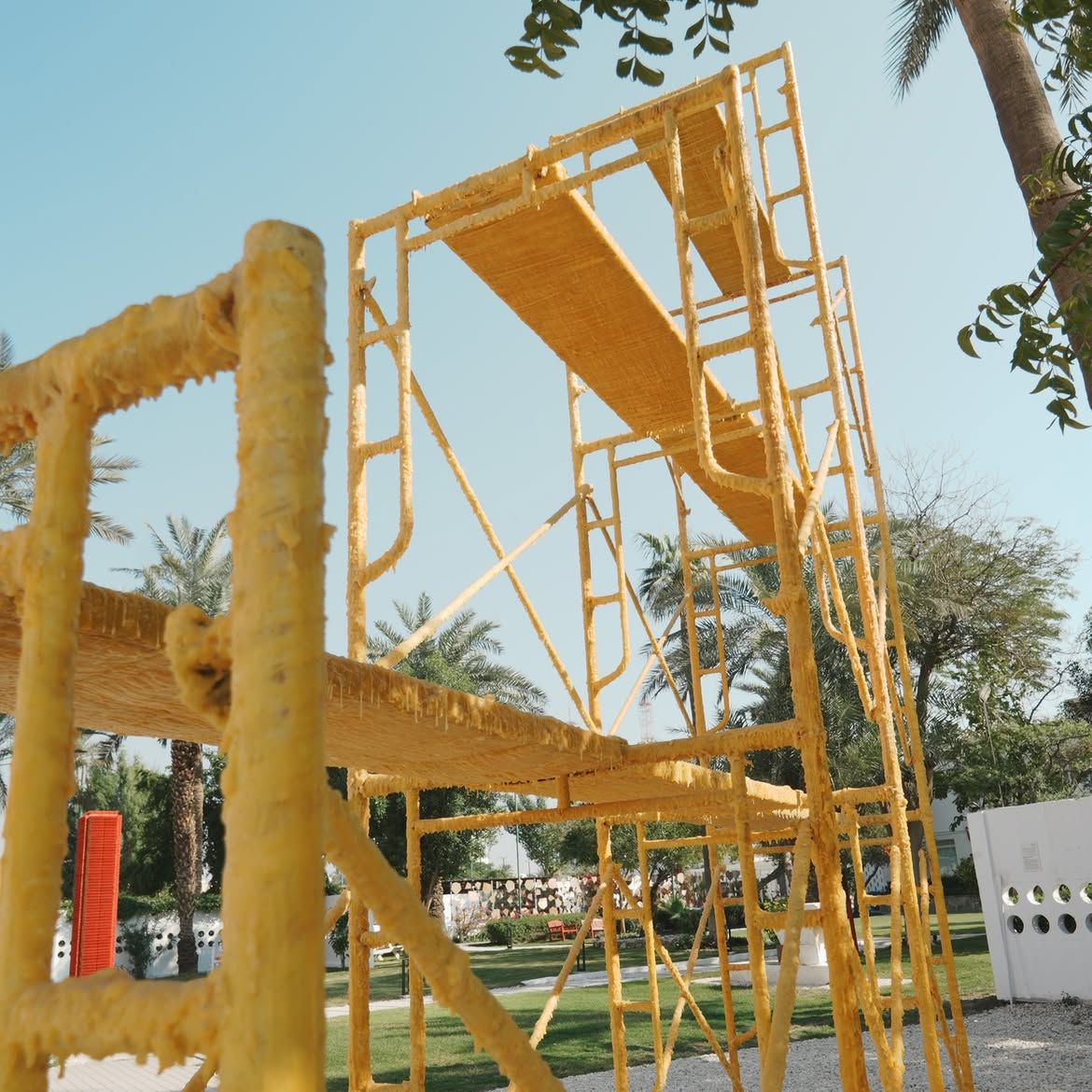
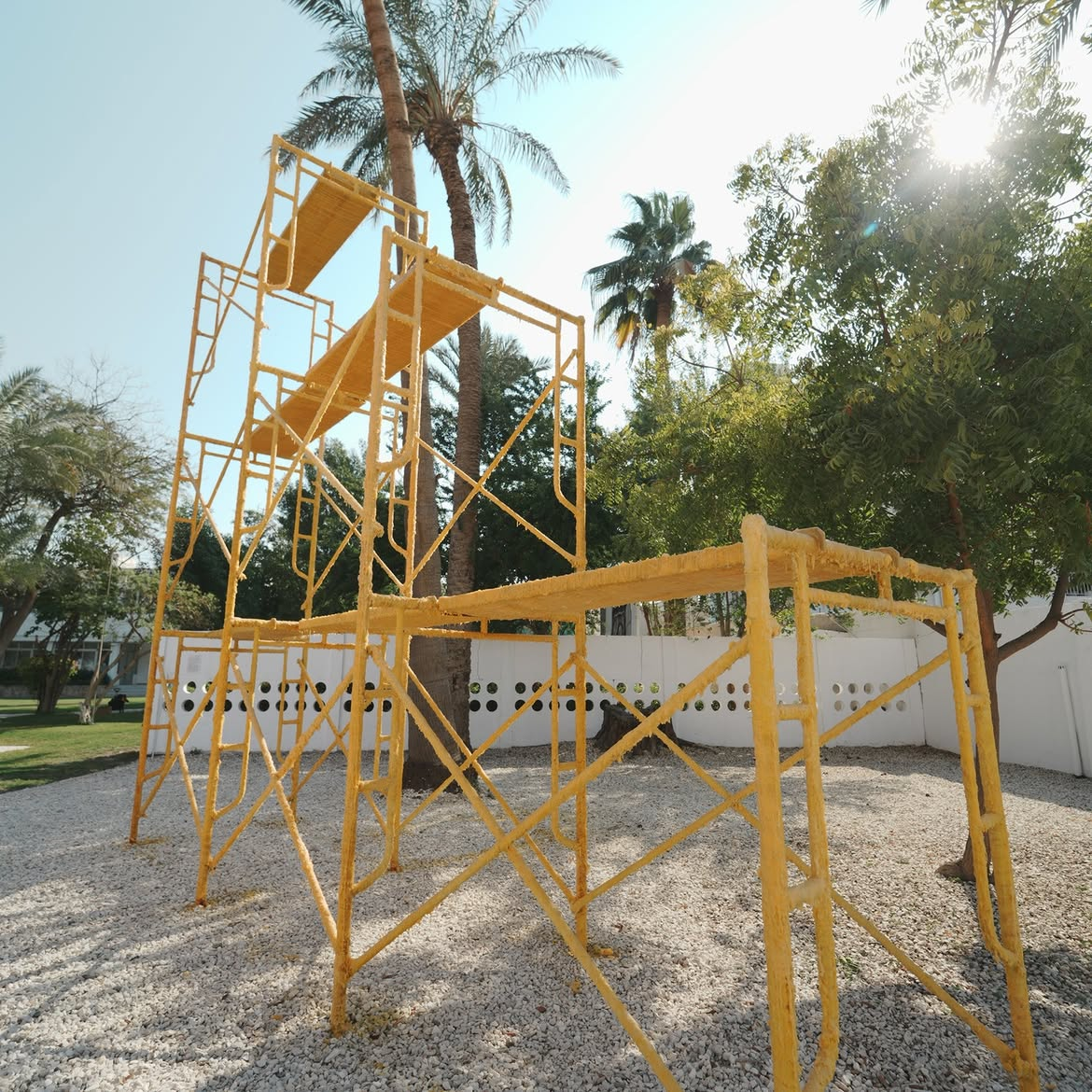
Where Are the Builders (2024) by Hatem Al Ahmad, a wax scaffolding installation that brings attention to temporary support structures and the often unseen labour behind finished buildings.
Hatem Al Ahmad’s work may move across painting, installation, archives, and environmental research, but the method remains consistent: begin with a question, follow the evidence, and let the research determine the form. His position at “zero” is central to that process. Rather than making himself the subject, he creates space for systems, histories, species, and relationships to lead the work.
Shaped by Asir’s landscapes and the logic of software engineering, his practice treats art as a form of investigation, where the final work emerges only after the pieces have been carefully brought together.
Stay close to Hatem Al Ahmad’s evolving artistic practice and upcoming projects through his Instagram.
We’d love to hear from you! Reach out to share your own artistic journey.